
What is a transparent LED screen exactly?
Transparent LED screens rely on a LED display technology radically different from that of traditional opaque screens. Their mesh structure, composed of thin bars equipped with LEDs spaced 4 mm to 10 mm apart, lets natural light pass through while delivering bright, dynamic display. Depending on the chosen pixel pitch, LED screen transparency can range from 70% to 95%, while a standard LED screen completely blocks the view.

Mesh architecture and natural light transmission
The mesh structure — as used in the XMS mesh LED screen — gives transparent LED screens their visual identity: the regular spacing of components allows optimal light circulation without compromising either resolution or brightness. The smaller the pixel pitch, the higher the resolution and the slightly reduced transparency. For example, a pitch of 2–5 mm offers about 60 to 70% transparency, while a pitch of 10–20 mm reaches 80 to 90%, but with lower detail rendering.
- Optimal light transmission: between 70% and 95% depending on LED spacing, perfectly suited to each type of application.
- Ultra-thin PCB frame: only 5–10 mm thick, compared to 30–50 mm for a standard LED panel, facilitating integration on glass surfaces.
- Lightweight substrate: made of PET or 1–3 mm sheet glass, guaranteeing both robustness and ease of installation.
When the LED display is turned off, the transparent LED screen becomes nearly invisible, letting ambient light pass through and creating a highly prized “magic window” effect. This immersive aesthetic experience combines look and communication without obscuring the background, a major advantage for spaces where design matters as much as the message.
Comparison of transparent versus opaque structures
The fundamental difference between a transparent LED screen and a standard LED screen lies in their relationship to light. Traditional screens, often made of aluminum or plastic 10–30 mm thick, use a black mask that absorbs ambient light. In contrast, the mesh structure of transparent models allows natural light to pass through the screen, offering remarkable transparency.
Weight also widens the gap between these two display technologies: a transparent LED screen weighs between 5 and 10 kg/m², while an opaque module can weigh 20 to 35 kg/m². This lightness facilitates installation, reduces the need for structural reinforcements, and lowers associated costs — a decisive advantage for many projects.
Magic window effect and background visibility
The “magic window” effect lets you overlay animated content on a clear view of the background: with 80% transparency, passersby clearly distinguish the scenery behind the screen, while the LED display broadcasts striking messages. Resolution remains sufficient to display text, logos, or smooth animations, even on large surfaces.
Thanks to this visual discretion, transparent LED screens preserve the aesthetics of boutiques, museums, or upscale headquarters. Unlike bulky traditional screens, they elegantly integrate into existing architecture, highlight displayed products, and enhance the user experience. All of these applications demonstrate the superiority of this innovative display technology.
Brightness and contrast: advantages of each technology
Screen brightness and display contrast mark a notable difference between the performance of transparent LED screens and traditional LED screens. These two parameters are crucial for ensuring good visibility even under high brightness, and they directly influence the visual impact of the content. Understanding these distinct advantages helps you select the solution best adapted to your installation and specific applications.
Comparative luminous performance of both technologies
A transparent screen typically offers a maximum brightness between 3,000 and 5,500 cd/m². In contrast, opaque screens often exceed 10,000 cd/m² to ensure perfect legibility in direct sunlight. This difference is explained by their distinct architectures: transparent LED screens prioritise transparency and cannot concentrate as much light without compromising transmission, unlike opaque panels designed to maximise brightness.
- Transparent screens: 3,000–5,500 cd/m². Ideal for storefronts or interior spaces with moderate lighting.
- Opaque screens: over 10,000 cd/m². Perfect for outdoor installations such as facades or stadiums, exposed to high brightness.
- Adaptive sensors: They continuously monitor ambient light to automatically adjust brightness and save energy.
- Self-emissive technology: In both cases, each LED generates its own light, eliminating the need for a backlight.
Thanks to their high brightness and black background that absorbs reflections, traditional screens maintain excellent visibility even under strong lighting conditions. For a storefront or a controlled interior, the luminous power of transparent LED screens is more than sufficient and offers the considerable advantage of transparency.
| Parameter | Transparent screens | Opaque screens |
| Max brightness | 3,000–5,500 cd/m² | 10,000+ cd/m² |
| Typical contrast | 5,000:1 | 10,000:1+ |
| Light transmission | 70–95% | 0% (full block) |
| Weight | 5–10 kg/m² | 20–35 kg/m² |
| Total thickness | 5–10 mm | 30–50 mm |
Contrast management and readability in variable conditions
The display contrast of a transparent screen typically reaches a ratio of about 5,000:1, while an opaque screen, thanks to its light-parasite-absorbing black mask, often exceeds 10,000:1. Under strong sunlight, light passing through the panel can reduce contrast perception, a phenomenon called “wash-out,” making carefully adapted content design crucial.
- Dark backgrounds recommended: Using a black or very dark background significantly improves the readability of a transparent screen facing high brightness.
- Dynamic regulation: Sensors automatically adjust brightness and gamma to maintain good contrast while saving energy.
- Dedicated calibration: A professional setup guarantees uniform colour and consistent contrast across the entire screen surface.
Both types of screens offer a viewing angle of about 160° horizontally and vertically. However, the transparent screen achieves its maximum display contrast between 30° and 60°; beyond this angle, visual quality gradually decreases.
Adaptive solutions for very bright environments
Integrating brightness sensors is an essential strategy for optimising transparent LED screens in areas where ambient light varies strongly. Real-time measurement allows automatic adjustment of screen brightness, maintaining optimal display contrast while reducing energy consumption.
Opaque screens remain the first choice for outdoor applications requiring the best visibility under direct sunlight. However, for indoor applications or storefronts exposed to moderate brightness, transparent LED screens equipped with adaptive regulation can save up to 30% energy while offering comparable visual advantages to traditional solutions.
Resolution and pitch: impact on LED display
The resolution of an LED display and its pixel pitch are critical for perceived sharpness, whether on a transparent or opaque screen. These two key parameters define the ideal viewing distance, image clarity, and the level of transparency available. Understanding their interaction is essential for selecting transparent LED screens perfectly suited to each use case, without sacrificing natural light contribution.
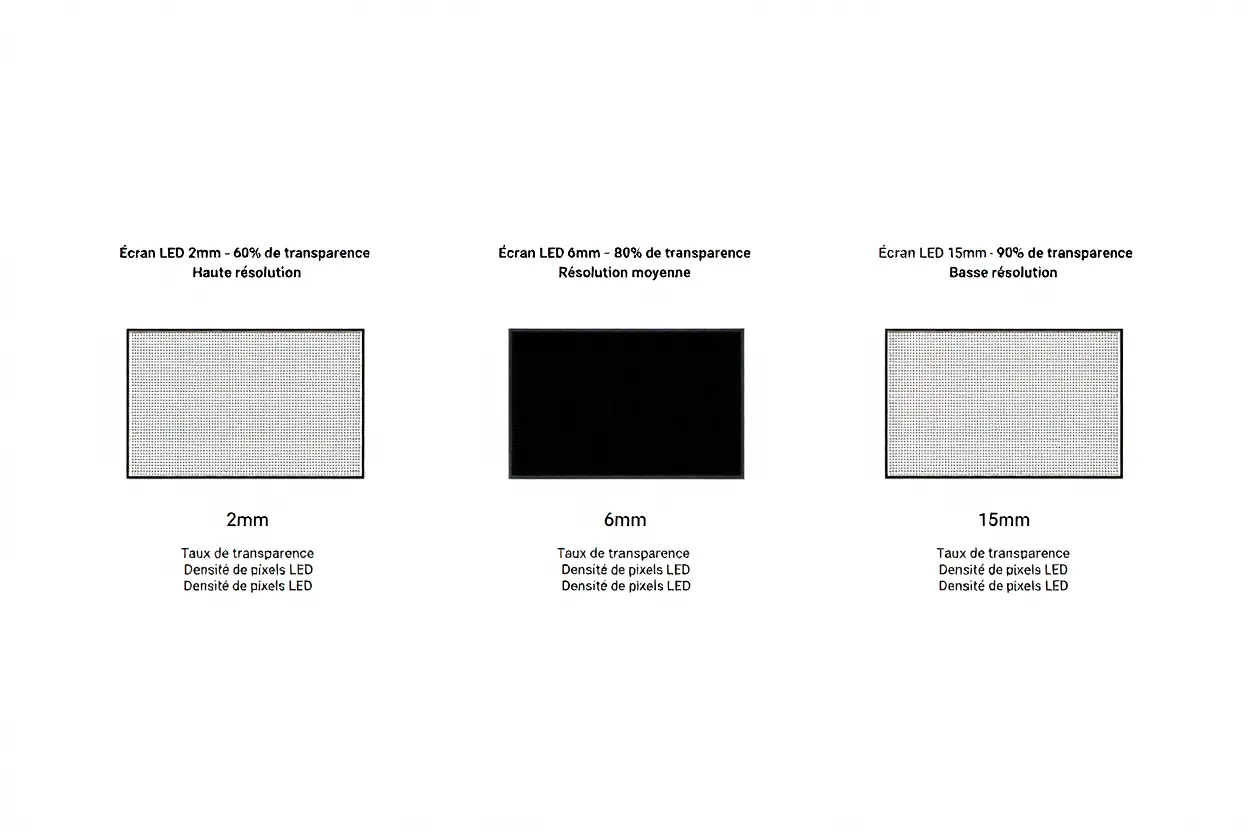
Pitch differences between transparent and opaque LED screens
On transparent LED screens, the pixel pitch generally falls between 4 mm and 10 mm, which directly impacts the fineness of displayed details. In contrast, opaque panels can achieve a much denser pitch, down to 0.9 mm, offering significantly higher resolution, visible even from very close up. This fundamental difference stems directly from their design: a higher LED density mechanically reduces transparency, creating a constant trade-off between visual rendering quality and light transmission.
Resolution versus transparency trade-off in display
A pixel pitch of 2 mm to 5 mm allows achieving about 65% transparency while maintaining perfectly adequate resolution — a perfect balance for demanding storefronts. Beyond 10 mm, transparency can rise to 90%, but image fineness and colour richness decrease significantly. Pitch selection should therefore be driven by the intended viewing distance: a Parisian jewellery store, for example, opted for a 6 mm pitch to create a harmonious balance between product visibility and the impact of promotional animations.
Opaque screens, for their part, are not faced with this dilemma: they block light entirely and can therefore focus on maximising resolution. The rule is simple: the smaller the pitch, the better the definition — a priority feature for spaces where the audience is close. Proof that the trade-off can succeed: in a shopping mall, two transparent LED screens of 8 m × 3 m with an 8 mm pitch demonstrated that a large surface can perfectly combine high transparency and high-performing LED display, despite a notable resolution difference with an opaque model.
Applications and installation: which traditional LED screen to choose
The applications of transparent screens and those using a traditional LED screen address distinct commercial or environmental needs. To make the right choice, it is essential to analyse the desired level of transparency, the intended visual impact, and the structural and energy constraints related to the installation site.
Use-case scenarios for transparent LED screens
Transparent screen applications are ideal for store storefronts, reception halls, museums, or any space where it is necessary to maintain product visibility while displaying digital content. Thanks to their high transparency, an indoor transparent LED screen overlays information and décor with elegance, without masking the background, transforming a simple glass surface into a communication medium that is both hybrid and attractive.
During temporary events such as trade shows or exhibitions, transparent LED screens stand out for their fast, lightweight LED screen installation: two days suffice for 10 m², half the time needed for opaque panels. This responsiveness lets you adapt the scenography to a often tight schedule, while maintaining excellent visual clarity.
- Automotive showrooms: a transparent screen placed on a window displays vehicle specifications without hiding the displayed model.
- High-fashion boutiques: fashion show videos can be broadcast in front of the window while letting customers see the outfits inside, creating a unique visual immersion.
- Museum spaces: historical commentary or information appears in front of artefacts, enriching the visit without altering the view of exhibited pieces.
In contrast, standard LED screens remain the reference for outdoor advertising, stadiums, transit, or facades requiring maximum contrast, even in direct sunlight. In these contexts, luminous power takes priority over architectural transparency, which explains the preference for traditional screens.
Installation ease and mechanical constraints compared
Transparent LED screen installation generally relies on a plug-and-play system, fixed directly to the glass or suspended, limiting work to one or two days for a medium-sized surface. Their reduced weight, between 5 and 10 kg per square metre, avoids any costly reinforcement of existing structures and greatly simplifies logistics.
A traditional LED screen, meanwhile, weighs 20 to 35 kg per square metre and requires a rigid aluminium chassis, reinforced anchoring, and sometimes civil engineering work. Transparent LED screens can be easily cut to adapt to curves or complex openings — a design freedom impossible with opaque panels, making them particularly valuable during heritage renovations.
Thanks to their aluminium frame and glass or polycarbonate panels, transparent LED screens offer IP65 waterproofing, suited to storefronts or semi-outdoor zones. Traditional screens only achieve similar protection with an additional housing, which adds weight. Moreover, their power consumption, between 150 and 800 W/m², remains about 30% lower than that of opaque panels — a non-negligible asset over the long term.
Maintenance and energy consumption over the long term
Each module of a transparent screen can be replaced individually, simplifying preventive maintenance and reducing downtime. Traditional screens often require complete panel removal, increasing the duration and cost of interventions. Passive heat dissipation in transparent LED screens also eliminates the need for fans or liquid cooling circuits, reducing failure risks.
A two-square-metre transparent screen consumes between 300 and 1,600 W, compared to 2,000 to 3,500 W for an opaque panel of equivalent size — annual savings can reach €200 in continuous operation. Given the 50,000 to 100,000-hour lifespan of a standard LED, this consumption difference improves the return on investment, despite comparable purchase prices.
LED longevity remains high for both screen types, but the simplified architecture of transparent LED screens involves fewer components, limiting failure risks. Traditional screens still hold an advantage in extreme environments, such as highly corrosive maritime zones or regions with harsh winters, thanks to their more robust hermetic housings.
Frequently Asked Questions
What is the main difference between transparent LED screens and traditional LED screens?
The main difference lies in the screen architecture: transparent LED screens use an innovative mesh structure that allows 70% to 95% of light to pass through, enabling visibility through the display. Traditional screens, on the other hand, are designed to be completely opaque, improving contrast but eliminating any transparency. This distinct design directly influences resolution, brightness, and weight: transparent screens typically weigh 5 to 10 kg/m² with brightness of 3,000 to 5,500 cd/m², while opaque models display 20–35 kg/m² and often exceed 10,000 cd/m². The choice between the two therefore depends on whether you need background visibility or maximum visual impact.
Are transparent LED screens suitable for very bright outdoor environments?
Thanks to their high transparency, transparent LED screens offer good readability in indoor or semi-shaded environments where ambient brightness is moderate. In direct sunlight, their brightness, below the 10,000 cd/m² of traditional screens, can lead to a “wash-out” effect (colour crushing). However, adding adaptive light sensors or using dark-background content significantly improves visual quality and readability, even under challenging lighting conditions.
What is the long-term installation and maintenance cost for each technology?
The installation of a transparent screen is notably faster and simpler, mainly thanks to its reduced weight that avoids heavy support work. For example, expect about two days to install 10 m², compared to three to four days for an opaque model of the same size. Over the long term (for example, over ten years), lower electricity consumption and the ease of replacing modules significantly reduce energy and maintenance costs, making transparent LED screens an economical and profitable solution, particularly for permanent installations like store storefronts.