
This guide helps merchants and agencies choose the right transparent LED screen for storefront displays: available technologies, selection criteria, regulations, and return on investment — so you can decide with precision.
Which transparent LED screen to choose for your storefront
Choosing a storefront screen is not just about comparing technical specs. You need to connect the technology to your store layout, the glazed area, the expected transparency level, and the type of content you’ll broadcast. From the design phase, the result depends on the structure chosen and its place in the storefront.
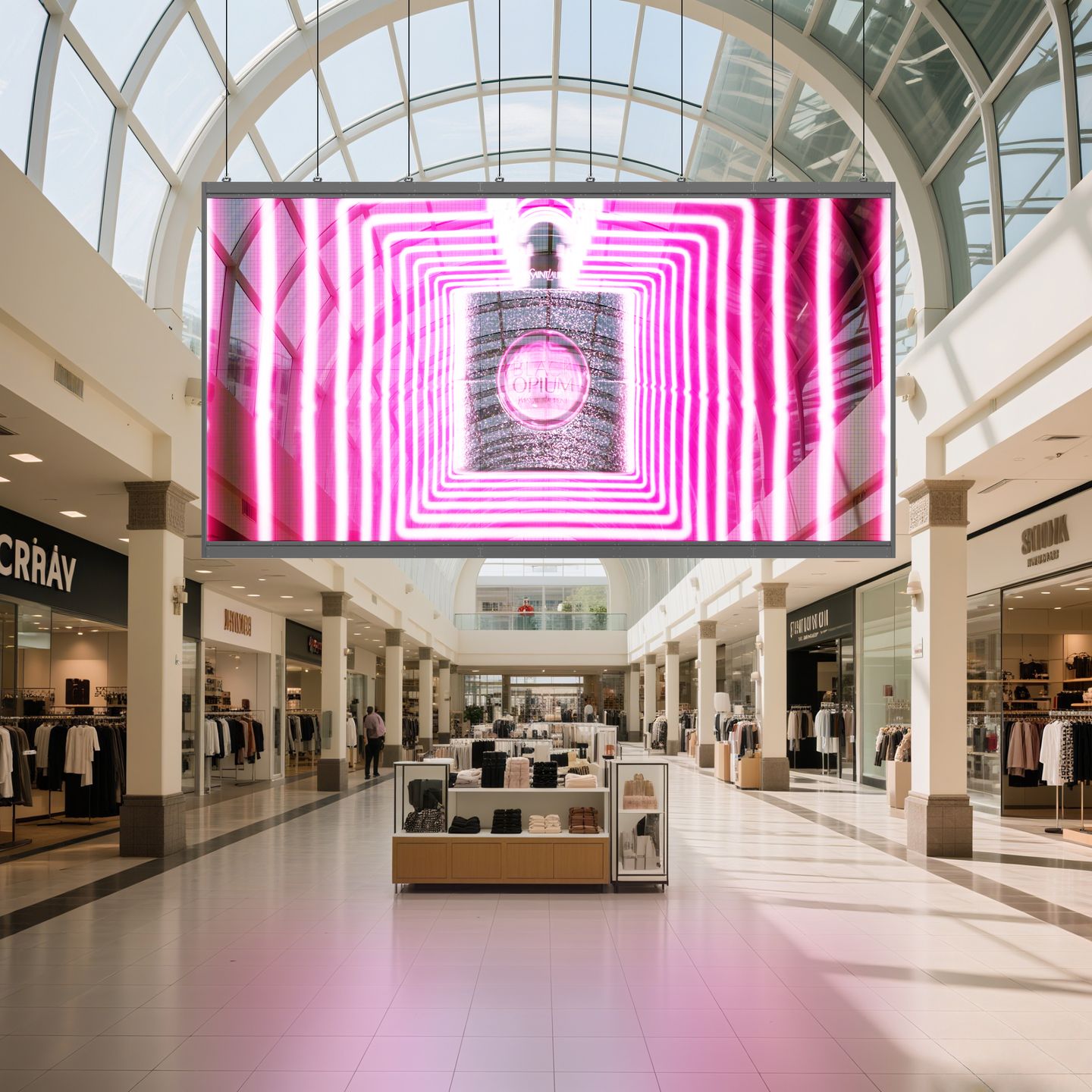
Limpide and Mesh Technologies for Storefront LED Screens
Transparent screens do exist: depending on their design, they achieve between 70% and 99% transparency. Two families dominate for LED storefronts: Limpide and Mesh, with distinct uses in real installations.
- Limpide (LED sheet glass) : 86 to 99% transparency, IP68 protection, shock resistance, water cleaning, compatibility with public-access buildings (ERP) and outdoor installations; weight of 40 to 60 kg/m², pitches from P3 to P60.
- Mesh (aluminum mesh) : 70 to 80% transparency, weight under 15 kg/m², modular panels 1000 × 500 mm, quick installation for a shop or point of sale indoors.
- Mesh caveat : the perforated structure progressively traps dust, which degrades the visual effect over time; the PCBs and solder joints are exposed to air, unlike an IP68 Limpide system.
- Other technologies : transparent LCD, transparent OLED with better contrast and lower power consumption, or flexible modules for curved surfaces — these complement the offering for specific architectural projects.
The available range on transparent LED screen and on transparent LED screen notably includes the MESH-XM, MESH-XMS, XFH and XW 5/8 references, with aluminum profiles and controllers.
Transparent LED screen vs. standard wall screen
The choice immediately changes the perception of the facade. An opaque LED wall screen cuts the view inside and reduces natural light on the covered area. Conversely, a transparent LED panel preserves the facade reading, keeps the storefront alive, and maintains the visual link with the interior of the store.
When integrated into a glazed wall, the whole functions as a discreet transparent LED wall, without any extra structure that’s too visible. What the eye retains is the continuity between the support and the place. A transparent LED screen from FlexLedLight can be deployed in plug-and-play mode and controlled from a smartphone, which simplifies daily operation of a digital display.
The difference plays out in integration: a transparent storefront screen fits into the design of the shop while broadcasting a dynamic message at the window. A well-positioned storefront LED screen draws pedestrians without visually cluttering the LED storefront composition.
Formats and modularity depending on store architecture
This integration logic requires formats adapted to the building. FlexLedLight offers LED panels in very large formats, with cutting options useful for asymmetrical storefronts, large bays, or less regular compositions. In this context, a transparent screen is not just for broadcasting content: it becomes part of the decor, especially when the light content needs to integrate with the facade architecture.
1000 × 500 mm Mesh panels bring precise modularity. The LED display surface adjusts to the available glazed area, which allows a storefront LED screen or a storefront screen to cover an entire bay without cutting or material waste. The LED storefront screen presents this type of usage for a point of sale seeking a device readable from the street.
As soon as a storefront takes a curved or inclined shape, flexible modules become more relevant than rigid formats. The preliminary study then focuses on mounting, pitch, and electrical supply, because the result depends on reading distance, ambient lighting, and the distance of pedestrians.
Brightness, regulation, and screen management in a store
Once the technology is chosen, the effectiveness of a storefront LED advertising screen comes down to two very practical settings: brightness first, then the regulatory framework tied to its installation. These parameters affect both the readability of the message and the ease of daily operation.
Brightness and readability of a storefront screen in full daylight
LED screen brightness is measured in nits. For a storefront screen exposed to strong natural light, models designed for this use reach 5,000 to 6,000 nits — a high brightness level suited for direct sunlight. Conversely, a storefront LED screen placed on the interior side, or in a less exposed storefront, operates efficiently in a range of 2,000 to 4,000 nits.
As soon as the bay faces directly south or west, aiming for more than 4,000 nits becomes relevant. The result depends on the orientation, the depth of the display case, and reflections on the glazing. A built-in photometric sensor then allows automatic adjustment of the brightness of the screen according to sunlight, without manual tweaking.
Regulation for interior LED advertising screens
An interior LED advertising screen installed behind a storefront generally falls under a more flexible regime than an exterior device. In most cases, a preliminary declaration at city hall is sufficient, without needing a building permit. This distinction matters especially when the LED display must integrate into an existing commercial facade.
Shutdown between 1:00 AM and 6:00 AM is still required. Once the installation is finalized, this range is automated via the control software, securing compliance without on-site intervention. In protected zones, the Limpide technology eases administrative acceptance by integrating into existing glazing and limiting the visual impact on the facade, especially when light is part of the decor.
Content management and remote control
Managing a storefront advertising screen can be done via USB key, remote software, or from a smartphone, depending on the chosen configuration. For a shop, this choice has a direct impact on retail responsiveness: updating an offer, changing a visual midday, or adapting an advertisement to a local event.
Android or Windows environments also allow connecting business applications. The difference lies in integration: a well-configured system reduces manual interventions to zero during the day. In a point of sale network, a centralized platform maintains LED display consistency while letting each site adjust its own content.
- Smartphone control : modify content in real time, from anywhere, without on-site intervention.
- Scheduled programming : automatic shutdown at night and playlist rotation according to commercial hours: morning, noon, evening, or promotional periods.
- Multi-site management : coordinated distribution for multiple stores, with local adaptation of the LED advertising screen according to the product category or store promotions.
Over time, the equation remains favorable. With an estimated lifespan of 80,000 to 100,000 hours — over 18 years at 12 hours per day of use — a storefront LED advertising screen is a long-term investment. Compatibility with standard 110–240V power avoids heavy electrical modifications in the shop.
Price, consumption, and ROI of a transparent LED screen
Evaluating the budget for a transparent LED screen in a shop is not just about the purchase price. You need to relate three variables: acquisition cost, energy consumed, and expected commercial effects on the storefront, LED display, and point of sale.
Cost of a transparent storefront LED screen by technology
The chosen resolution level and pitch directly impact the transparent LED screen price per m²: a fine pixel pitch, like a P3 for close reading, requires more components and drives up the budget. Conversely, a wider pitch like P60 works better for a large surface viewed from a distance, at a lower cost.
This technical choice also affects operating cost. On this point, the transparent LED screen electrical consumption remains a concrete argument, especially when brightness is automatically adjusted by a sensor. The 110–240V compatibility also simplifies installation in an existing store, without heavy electrical modifications.
- Price range : between €2,000 and €4,000 per m² depending on technology, pixel density, and installation complexity.
- Additional costs : preventive maintenance, content management, aluminum profiles, controllers, and power supplies must be included in the overall budget.
- Average consumption : a transparent video screen of 2 m² consumes between 150 and 300 W.
- Required power supply : standard 110–240 V, compatible with most existing commercial installations.
Two families dominate digital display on glazing. A tempered glass Limpide model targets contexts where durability, shock resistance, and IP68 protection matter, especially on a facade or in an exposed environment. A Mesh model, lighter and more affordable, suits a storefront LED advertising screen indoors when modularity and initial budget control take priority. The result depends on reading distance, ambient light, and expected transparency.
| Criterion | Limpide Technology | Mesh Technology |
| Transparency | 86–99% | 70–80% |
| Weight (kg/m²) | 40–60 kg | < 15 kg |
| Max. brightness | 6,000 nits | 5,000 nits |
| IP protection | IP68 | IP not certified |
| Recommended application | Outdoor, ERP, protected zones | Indoor commercial storefronts |
| Price range (€/m²) | €3,000–4,000 | €2,000–3,000 |
Electrical consumption and energy savings in a store
Once the technology is chosen, look at the operating cost. The added structure of Mesh and the low LED density of Limpide translate into contained energy expense, particularly noticeable on installations operated daily at high brightness. In real-world installations, this gap matters most for storefronts lit over a wide schedule.
Transparent LED panels paired with a photometric sensor automatically adjust power according to outside light. As soon as sunlight drops, the transparent storefront screen reduces intensity without losing visibility from the street. This allows reducing consumption by 30 to 50% during off-peak hours, provided the threshold setting is adapted to the storefront orientation and the ambient light level.
Return on investment and commercial advantages
Energy savings reduce operating cost; commercial performance determines how quickly the investment is recovered. Dynamic content attracts more attention than a static visual, and sector studies note a 20 to 35% increase in foot traffic after installing a storefront LED advertising screen. Especially valuable when light is part of the decor, in particular on a commercial street where the facade must capture attention without masking the interior.
- Print savings : campaigns refresh without re-printing posters, adhesives, or temporary supports.
- Commercial responsiveness : promotions, launches, and events update quickly, without physical intervention on the storefront.
- Lifespan : 80,000 to 100,000 hours of operation allow recovery over 18+ years at 12 hours of display per day.
- Multi-site consistency : for multiple points of sale, centralized management maintains homogeneous display while authorizing local adaptations.
The drop in print costs, combined with the observed traffic gain, makes a return on investment in two to four years feasible depending on the surface, the business sector, and the quality of the content broadcast. Once the installation is finalized, the economic result depends as much on the chosen format as on the update rhythm, the brightness level, and the relevance of the digital display throughout the day.
Frequently asked questions
What is the price of a transparent LED screen for a storefront?
The price of a transparent LED storefront screen generally ranges between €2,000 and €4,000 per m². This estimate varies depending on the technology chosen (Limpide or Mesh), the pitch, therefore the pixel density, the surface to cover, and the installation constraints on the existing storefront screen or facade.
Several additional cost items often come with this budget: mounting accessories, maintenance, and a content management solution to control the screen. The difference plays out in integration: a simple storefront to equip in a store does not require the same level of intervention as an installation on a large shop window.
A custom FlexLedLight quote allows refining the actual cost according to the site architecture, the expected brightness level, and visibility goals.
Which transparency and brightness to choose for a store display screen?
The right transparency level first depends on the location. For a storefront screen installed inside a store, 70 to 80% transparency in Mesh technology preserves product reading and visibility into the interior. Conversely, for an exterior facade or a zone under more visual constraints, 86 to 99% transparency in Limpide technology suits a transparent screen better.
Regarding brightness, 2,000 to 4,000 nits suffice for a storefront that is sheltered. Beyond 4,000 nits, the transparent LED screen maintains good readability in full sun. The result depends on sunlight, but also on the observation distance and each pixel’s pitch.
A system equipped with a photometric sensor automatically adjusts intensity according to ambient light. This regulation prevents over-brightness, improves visual comfort, and maintains the impact of a storefront LED screen in a shop throughout the day.
How to install a transparent LED screen at a store front?
Installing a transparent screen at a storefront most often relies on standard mounting structures, 110–240V power, and plug-and-play operation.
Mesh panels, lightweight (under 15 kg/m²), mount quickly. Limpide technology, meanwhile, integrates directly into existing glazing by replacing the glass, without major construction. This is ideal when light is part of the decor, especially for a shop that wants to preserve transparency while adding a screen visible from the outside.
On the administrative side, a storefront installation generally requires a preliminary declaration at city hall. FlexLedLight provides a technical assessment before installation and accompanies the project through to commissioning, to ensure coherence between site constraints, visibility level, and real-world usage of the storefront LED in the store.