
Choosing the right LED screen size for a project requires balancing several factors: pixel pitch, viewing distance, screen format, resolution level, and on-site constraints — both indoors and outdoors. The guidelines below help you evaluate screen size, understand the key characteristics of large LED displays, and select a coherent configuration, whether you’re considering a standard LED screen or a fully custom solution.
Standard Sizes and Formats for Large LED Screens
A large LED display is not like a consumer television. Its modular structure allows you to assemble panels into a very compact surface — or, conversely, cover an entire façade. What really matters is the integration: the screen size depends as much on the desired visual impact as on audience distance and the visibility you want to achieve.
This is why the specifications of large LED screens are never limited to a single size in inches. You also need to consider the screen format, the usable resolution, and how each LED module fits into the overall installation.
What LED screen formats are available?
In 16:9, standard dimensions range from 250 × 150 cm to 900 × 500 cm. This range covers most use cases: conference rooms, showrooms, stages, sporting events, or large-scale communication installations.
Size in inches gives you a reference point compared to common audiovisual equipment, but the actual visual result depends on viewing distance, pixel pitch, and the resolution of the content being displayed.
- 110 inches (2440 × 1370 mm): suited for conference rooms and showrooms, with a comfortable viewing distance of about 2.5 to 4 meters.
- 138 inches (3050 × 1710 mm): appropriate for intermediate events, comfortably readable at 4 to 5 meters.
- 165 inches (3660 × 2050 mm): ideal for exhibition halls or festival stages, with a recommended viewing distance of 5 to 7 meters.
- 220 inches (4880 × 2740 mm): designed for large sporting or architectural installations, with good visibility from 8 to 11 meters.
These formats align with current Full HD and 4K content standards. The LED screen at the Stade de France, visible to 100,080 spectators, demonstrates just how far modular assembly can go when the primary goal is long-distance visibility.
Custom and modular formats for every installation
Once standard sizes no longer fit the space, custom LED screens take over. The principle remains the same: a modular system composed of panels assembled to match the target format, without strict proportion constraints.
For example, FlexLedLight offers 960 × 400 mm modules for 75% transparency configurations, as well as 1000 × 2000 mm to 1188 × 2750 mm surfaces for 90% transparency versions. The final LED screen size is finalized through 3D modeling, with an average manufacturing lead time of about eight weeks.
Once the installation is complete, this choice has a direct impact on operation. A custom LED screen adapts to curved walls, asymmetric spaces, or segmented surfaces, while individual module replacement simplifies maintenance and ensures long-term display continuity.
Transparent and unconventional formats for architectural integration
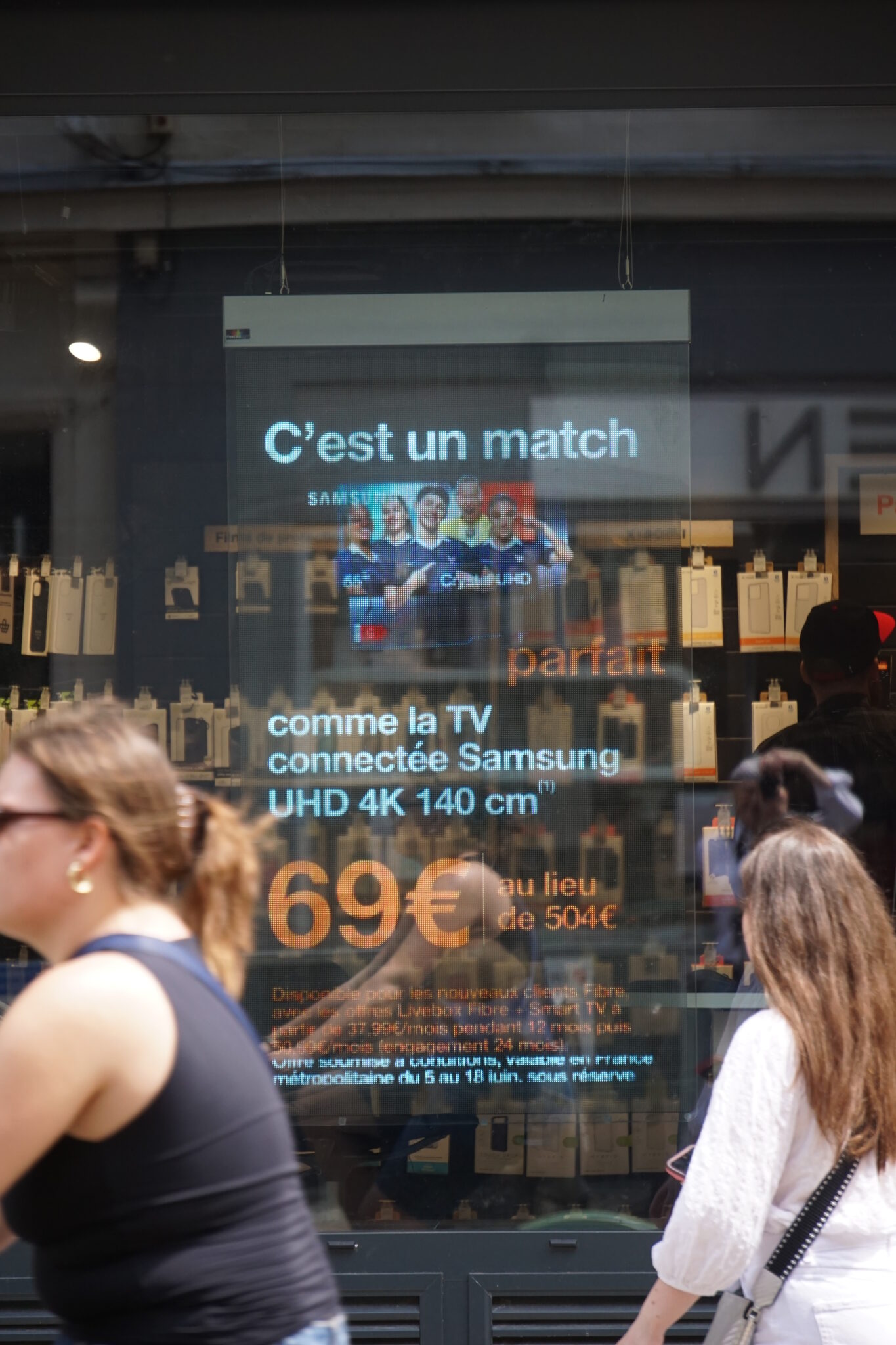
When the display needs to coexist with daylight or maintain a see-through view, transparent formats become relevant. Transparent LED screens from the Fantasign range come in 75% and 90% transparency levels, with Mesh Screen models like MESH-XM or XFH, as well as Transparent Video LED Glass Screen models depending on site constraints.
Outdoors, in a shop window, or in an atrium, visibility then depends on the balance between transparency, brightness, observation distance, and perceived resolution. What matters most is content readability without disrupting the existing architecture.
Beyond standard rectangles, some installations require round, concave, convex, or angular shapes. The Digital Wallpaper LED paper from the European Digital Wallpaper project illustrates this approach — ultra-thin, formable panels that can be cut into almost any shape and applied to walls or ceilings, consuming up to 30% less energy than conventional solutions.
The 16:9 Ratio and LED Display Size
The 16:9 format dominates most current video applications: sports, cinema, events, corporate communication. Understanding the 16:9 ratio for LED screens lets you translate a content standard into real dimensions, then into a display surface that matches the space, distance, and expected visibility.
Why the 16:9 format dominates large LED screens
The principle is straightforward: 16 units wide for every 9 units tall. This ratio maps directly to the most widely used resolution standards, such as Full HD at 1920×1080 and 4K at 3840×2160. Whenever the source comes from a video routing system, broadcast camera, media server, or satellite feed, this format avoids cropping and distortion.
This alignment becomes critical on large LED panels. Once the installation is complete, the result depends on how well the content, source resolution, and physical proportions of the screen are aligned. The difference shows in the integration: a display designed from the start in 16:9 preserves readability of faces, text, and motion, indoors and outdoors.
On very large formats, modular technology can reach surfaces of 50 m² and more by assembling identical cabinets without fixed dimension constraints. What the eye perceives is the visual continuity of the display surface — provided the ratio, video processing, and cabinet assembly remain consistent across the entire diagonal.
LED screen size and viewing distance in 16:9 format
Screen size is never chosen in isolation. It’s defined by the available space, viewing distance, number of spectators, and the level of detail expected in the image. For a room of about 50 people at 4 meters distance, a 350×200 cm screen works well; beyond 8 meters, a 700×400 cm screen offers more comfortable reading.
Pitch choice directly affects perception: between 4 and 20 meters, the required sharpness varies by use case. At 10 meters, the visual difference between a 4 mm pitch and a 10 mm pitch becomes noticeably less significant, which often leads to a more cost-effective solution for large outdoor screens or certain indoor setups.
| Screen Size (16:9) | Optimal Viewing Distance | Recommended Use Case |
| 250×150 cm | 2.5 m | Meeting room, point of sale |
| 350×200 cm | 4 m | Conference room, showroom |
| 450×250 cm | 5 m | Indoor event, lobby |
| 550×300 cm | 6–7 m | Congress stage, exhibition hall |
| 700×400 cm | 8–9 m | Concert, indoor sporting event |
| 900×500 cm | 11 m | Stadium, festival, exterior façade |
Real-world examples of LED display sizes for events
For an outdoor cinema or festival, a 700×400 cm LED display comfortably covers an audience placed between 8 and 15 meters away. This setup remains suitable for up to about 500 spectators, with a large enough diagonal to preserve scene details and subtitles. Especially when ambient light is part of the atmosphere: at night, perceived quality also depends on real contrast and brightness settings.
At a stadium, the scale changes immediately. At a site like the Stade de France, with a field measuring 119×75 m and up to 100,080 spectators, LED panels must combine large screen size, a 140° viewing angle, and brightness suited to artificial lighting. In real installations, the balance comes down to mounting height, light output, and content segmentation — to maintain clear readability from the furthest stands.
TV Screen Sizes vs. Modular LED Video Walls
The gap between a large consumer TV and an LED video wall designed for real-world visibility becomes clear as soon as you think about actual use. On one side: domestic or semi-professional display. On the other: a modular solution built for large-scale applications, events, retail, or architectural integration.
The limits of TV screen sizes compared to LED solutions
Looking at commercially available TV screen sizes, the ceiling sits around 98 inches for LCD, OLED, and QLED models. That’s about 217 × 122 cm in 16:9. This limit exists because of single-panel manufacturing: the larger the screen, the more challenging the process becomes.
In contrast, an LED video wall is not locked into a fixed format. Its modular architecture lets you assemble modules to achieve the target screen size — whether that’s an indoor LED video wall, a digital signage display, or an outdoor LED screen. The difference is in the integration: a large TV is placed in a space, while an LED wall is built into it.
- Brightness: a large LED screen can reach 5,000 nits outdoors, compared to 800 to 1,200 nits for an OLED screen.
- Lifespan: an LED solution operates for 80,000 to 110,000 hours, versus 15,000 to 30,000 hours for a consumer TV.
- Format: the screen can become round, concave, or convex — something a standard TV panel cannot do.
- Maintenance: for large screens, each module can be replaced individually without dismantling the entire installation.
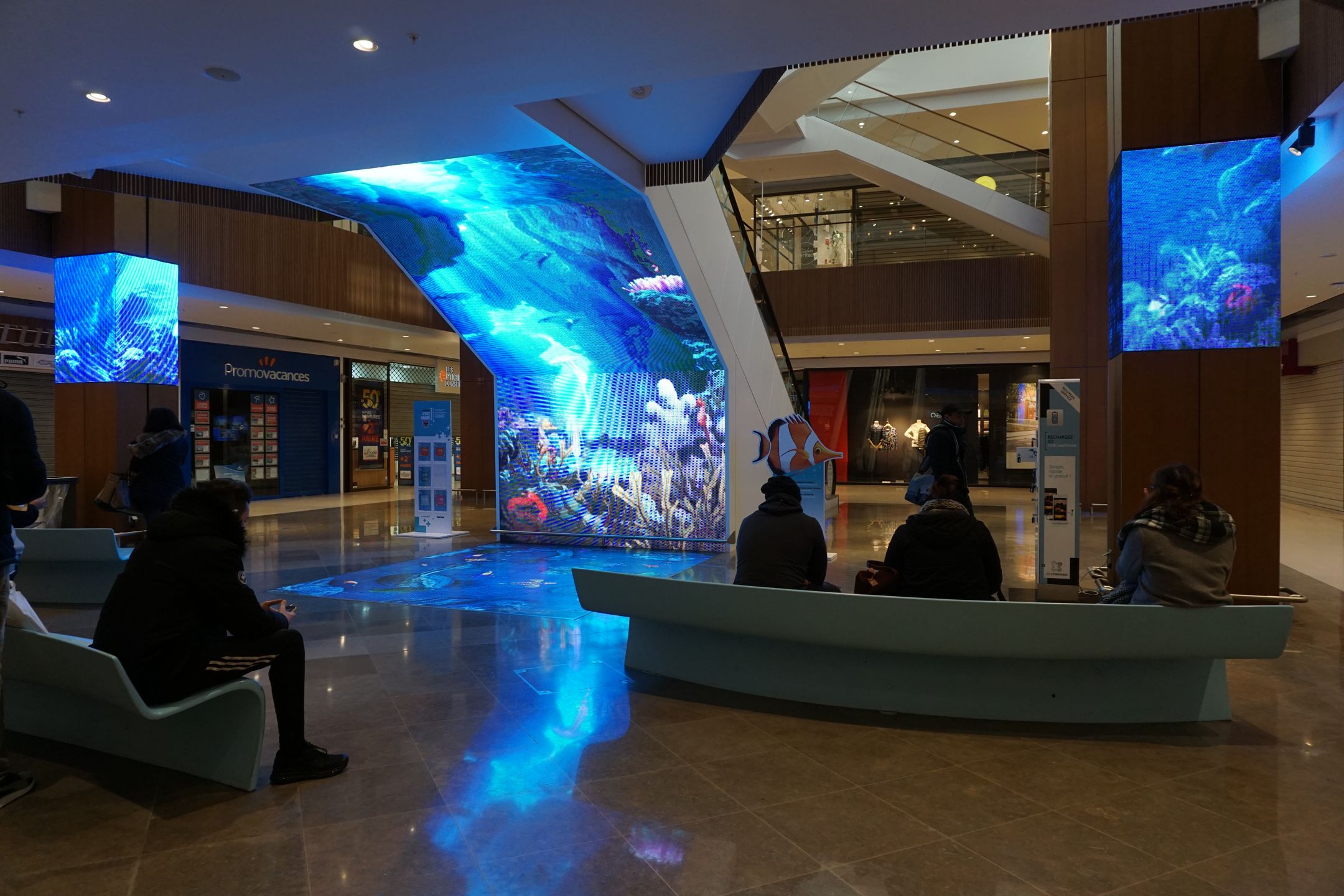
This logic is clear in indoor LED video walls visible at shopping malls or airports. An LED screen between 6 and 9 meters wide is common, while even the largest TVs remain out of scale for this type of use. In real installations, the ability to adapt the surface to the architecture changes both the visual impact and the feasibility of the project.
How pitch defines resolution and optimal size
LED pitch is the distance between each pixel in millimeters, and this choice directly determines perceived resolution based on viewing distance. A P2.5 pitch delivers a very sharp image from just 2 meters away — it suits indoor spaces, shops, and conference rooms. As the audience gets closer, this pixel density improves readability of text, faces, and graphic details.
Conversely, a 10 mm pitch makes full sense on an outdoor LED screen or very large space where viewing distance makes an overly dense resolution unnecessary. What matters is the fit between screen size, resolution, and viewing context. The result depends on audience distance, mounting height, and the type of content being displayed.
Indoor vs. Outdoor LED Screen: What Are the Differences?
The choice between indoor and outdoor use sets the technical specifications from the start: brightness, protection level, thermal management, usable size, and budget. When a project mixes both environments, image quality and installation durability can suffer in real-world conditions.
Brightness and recommended sizes for indoor LED screens
For an indoor LED screen, brightness typically sits between 800 and 1500 nits, and can reach 5500 nits in spaces with strong natural light. At this range, the image stays accurate without causing eye strain in a showroom, hotel, or museum. At close distances, pixel pitches from P2.5 to P4 provide the sharpness expected for detailed content. Ambient light sensors then adjust brightness based on artificial or natural lighting.
- Showroom and luxury boutique: P2.5 to P3 pitch, 800 to 1200 nits brightness, viewing distance of 2 to 5 meters to keep the image clean up close.
- Hotel lobby or atrium: wider format, P3 to P4 pitch, with levels going up to 5500 nits if the space receives significant natural light.
- Conference room or auditorium: P2.5 to P4 pitch, sized based on viewing distance and audience count, with a refresh rate of 3840 Hz or higher to ensure flicker-free video capture.
Some indoor environments exposed to strong solar gain approach outdoor constraints. The difference lies in the integration: you must measure the site’s light sources precisely before validating technology and sizing.
Technical specifics of outdoor LED screens
An outdoor LED screen generally needs to reach 5000 to 6000 nits to remain readable in direct sunlight. The enclosures are IP66-rated — they resist rain, dust, and large temperature swings.
The size increases too. An outdoor LED screen is often viewed from 15 to 20 meters away, sometimes more, justifying formats of 700 × 400 cm or 900 × 500 cm. At this distance, a 6 to 10 mm pitch remains visually coherent. What the eye perceives is overall readability, not fine detail at a few meters.
Once installed, thermal management becomes a constant consideration, especially in hot climates. FlexLedLight selects ventilated or fanless systems depending on the local context and mounting exposure. Energy not converted into light becomes heat: if dissipation is poorly calculated, component lifespan drops.
COB vs. SMD: which technology for which environment?
Technology choice extends these criteria. COB (Chip-on-Board) places LEDs directly on the chip, favoring uniform brightness and deep contrast — ideal when lighting is part of the decor in boutiques, museums, or hotels. SMD (Surface-Mount Device) positions LEDs on the surface and allows higher brightness with more design flexibility.
SMD is often more cost-effective and better suited to high-luminance environments, especially for outdoor LED screens or indoor screens exposed to strong daylight. The result depends on the use case, reading distance, light level, and available budget.
Installation, Control, and Innovations in Large LED Screens
Once the format, resolution, and technology are validated, daily operation depends on something else: the quality of LED video wall installation and mounting and the flexibility of the control system. These choices affect usability, maintenance, and the project’s total cost.
Mounting methods and configurations for LED video walls
LED video wall installation and mounting relies on several configurations, chosen based on the architecture, reading distance, and access constraints. Wall mounting remains the most common solution in permanent commercial spaces. Conversely, a suspended installation on steel beams improves visibility when the audience moves along multiple paths, while a freestanding floor structure suits temporary uses better.
- Wall mounting: direct attachment to the building structure, with a clean finish suited for commercial or permanent architectural environments.
- Suspended installation: ideal for lobbies, shopping malls, or arenas, as it opens up viewing angles and enhances video wall visibility.
- Freestanding structure: a mobile solution for festivals, booths, and events where the display surface needs to be moved or reconfigured.
- Magnetic configurations: some LED modules integrate magnetic mounting that speeds up installation and on-site maintenance.
This structural choice has a direct impact on specialized labor and budget. Once the installation is complete, a faulty LED module can be replaced individually without removing all the LED panels. In real-world use, this modularity reduces long-term maintenance costs, with an advertised lifespan of 100,000 hours for indoor screens.
Control system and content management
After mounting, the control system takes over. The most useful LED innovations for operation concern signal management: each pixel is controlled individually, multiple sources can be processed in real time, then adapted to the screen’s resolution. The result depends on the quality of this conversion, especially on a large display surface.
Content programming then simplifies daily operations: playlists, scheduled scenarios, synchronized distribution from a single server. This centralization becomes particularly valuable for digital signage networks spread across multiple sites, where visual consistency and responsiveness matter as much as the message itself.
Once Wi‑Fi connectivity is integrated, remote control becomes more flexible. A smartphone can be used to change content, adjust brightness, or track performance. The system can also correct colors, balance light intensity, and monitor temperatures to preserve components and maintain a uniform image across the entire display surface.
Technological innovations and the future of LED screens
LED innovations no longer concern only image quality. The European Digital Wallpaper project, led by LightnTec, illustrates a concrete evolution: ultra-thin, flexible, and rollable LED panels that can be applied like wall covering or ceiling treatment, then cut to any desired shape. This approach reduces weight and rigidity constraints — ideal when lighting is part of the decor.
The gain isn’t limited to visual integration. These solutions reportedly use up to 30% less energy than conventional LED devices — a gap that varies by use scenario and display load. Meanwhile, common-cathode technology can reduce power consumption by up to 75%, and modular segmented power supplies limit losses and simplify technical interventions.
What the eye retains is image continuity — but real performance always depends on the relationship between structure, control, resolution, and reading conditions at proper distance.
Frequently Asked Questions
What is the standard format for a large LED screen?
For a large LED screen, the 16:9 format remains the most common standard, both indoors and for presentation use. It comes in standardized dimensions ranging from 250 × 150 cm (suited for a viewing distance of about 2.5 m) to 900 × 500 cm (for comfortable reading at 11 m).
In inches, the most common reference points are 110, 138, 165, and 220 inches. However, modular technology opens a much wider range: screen size can be adjusted to the project, including in large dimensions, with concave or round versions when the architecture requires it — ideal when lighting is part of the decor.
What is the largest size available in modular LED?
In modular LED, there is no theoretical size limit for a large screen. Where consumer LCD or OLED TVs generally reach about 100 inches, an LED video wall grows by adding panels, without any format constraint imposed by the technology itself.
This applies both indoors and for outdoor projects. Stadium façades like the one at the Stade de France, or certain shopping mall video walls, show how far this expansion can go in real installations: several tens of square meters, depending on site criteria and structural capacity.
How do I choose LED screen size based on audience distance?
Proper sizing rests on three criteria: the distance between the audience and the screen, the pixel pitch, and the installation context (indoor or outdoor). What matters is the balance between display sharpness and actual viewing distance.
At close distance, a P2.5 pitch ensures excellent sharpness from just 2 meters away, which suits a shop or meeting room well. When the audience is 10 meters or more away, a 6 to 10 mm pitch remains visually effective and allows budget adjustment without degrading the experience.
Brightness should follow the same logic: 800 to 1,500 nits suffice indoors, while an outdoor screen in direct sunlight generally needs 5,000 to 6,000 nits.