
Understanding the power consumption of a giant LED screen helps you anticipate operating costs, properly size the electrical installation, and identify useful levers to reduce energy use. These technical benchmarks—power, brightness, usage intensity, and actual consumption—allow you to estimate a coherent energy budget from the project phase.
LED Screen Power Consumption by Power Rating
LED screen power consumption first varies with surface area, then with technology and operating conditions. In practice, professional giant LED screens typically fall between 200 and 400 W/m² in standard use, while maximum power can reach 2,000 W/m² when the LED screen operates at very high brightness.
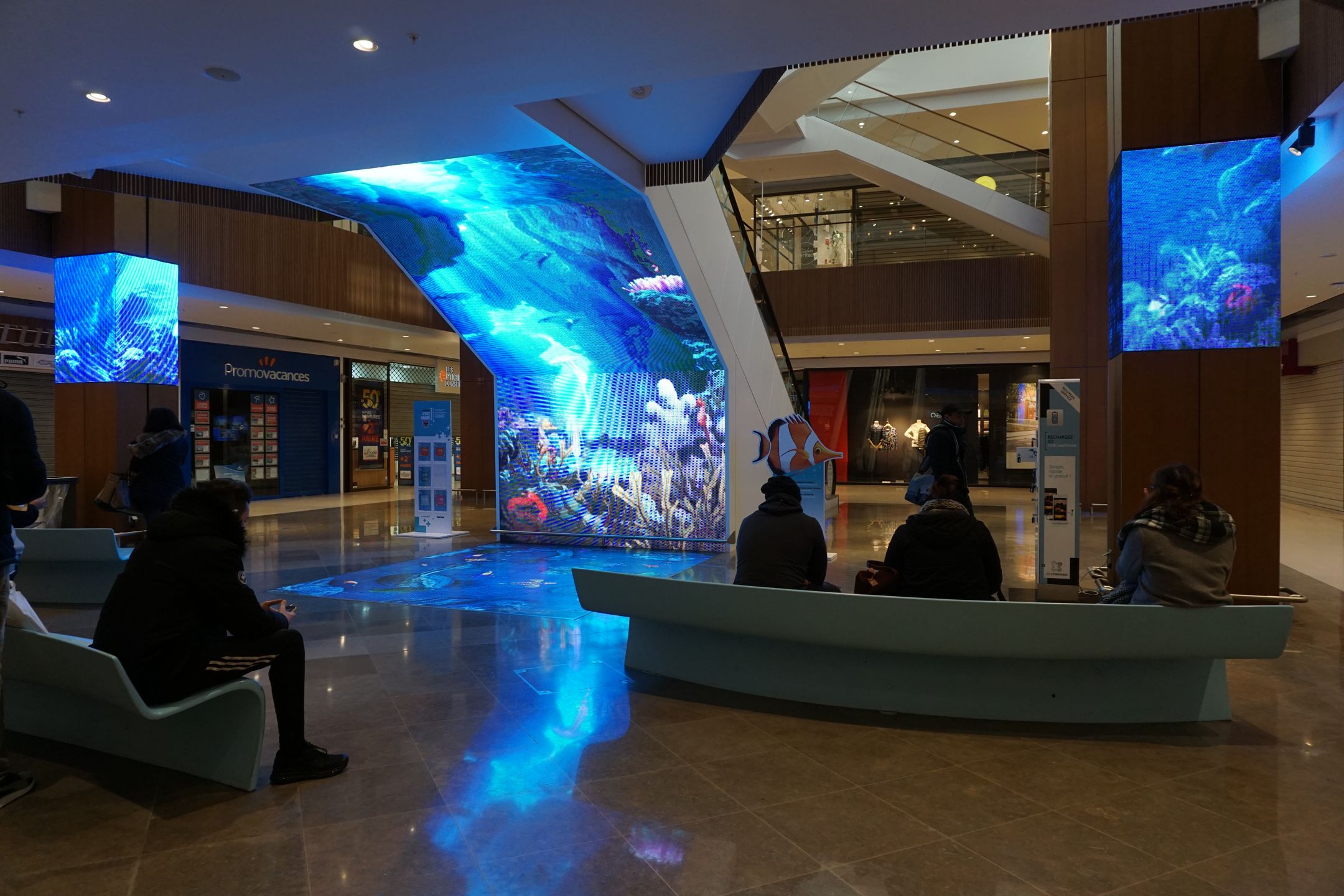
What Factors Influence LED Screen Energy Consumption
The content sent to the LED screen matters a lot: a white image simultaneously activates the red, green, and blue diodes, while a dark image significantly lowers the screen’s electrical power. The result depends on the mix of visuals broadcast, brightness settings, and usage context—both indoors and on facades.
- Displayed content: a white image can consume up to three times more than a dark visual, which directly affects the power consumption of a giant LED screen.
- Brightness level: an indoor screen typically operates between 800 and 1,500 nits, versus 7,000 to 10,000 nits outdoors, with an immediate impact on energy consumption.
- Pitch and pixel density: at equal surface area, a P1.5 runs around 300 to 350 W/m² while a P4 sits closer to 180 to 250 W/m².
Once the installation is finalized, actual consumption is often well below theoretical maximum power. With mixed content and automatic brightness management, electrical consumption frequently drops to 50 to 60% of peak value. An ambient light sensor can then reduce annual consumption by 30 to 40%, provided the settings are properly calibrated at installation.
Domestic vs. Professional LED Screen Electrical Power
The contrast is clear between residential and professional display use. The LED TV power of a 55-inch television sits around 80 W, while a 65-inch approaches 150 W. Conversely, giant LED screens start at around 200 W/m² and go much higher as soon as the application demands strong visibility.
Dynamic signage, advertising, or event applications do not require the same brightness level, operating hours, or power reserve. A 10 m² professional LED screen used 12 hours a day thus reaches 24 to 48 kWh daily, which helps estimate LED energy consumption over a month or year.
Electrical sizing does not stop at the nominal value. You need to include a 10 to 15% margin above maximum power to absorb conversion losses and auxiliary equipment. This electrical need drives the choice of power supply, protections, and electricity distribution on site.
How Pitch and LED Technology Affect Electrical Consumption
SMD modules are well-suited for environments with high ambient light, while COB seek better luminous uniformity and deeper blacks. Prefer COB when light is part of the decor: the technology choice affects both the energy consumption of the LED screen and its visual perception.
Pitch plays the same role. The tighter the pixels, the higher the power draw for the same surface, directly influencing LED screen electrical consumption. Scan rate also matters: lower ratios like 1/8 versus 1/32 limit peak power demand and relieve the power supply.
Some common-cathode systems go further by adjusting voltage per color—red, green, and blue. Depending on the chosen architecture, energy consumption can drop by 40% and up to 75% in the best configurations. The difference comes down to integration: to properly estimate the electrical consumption of a giant LED screen, read the power specifications, usage conditions, and brightness control strategy together.
How to Calculate the Electrical Consumption of a Giant LED Screen
Calculating the electrical consumption of a giant LED screen requires distinguishing three benchmarks: maximum power, average power, and installed power. Each corresponds to a specific use. The first protects the sizing, the second helps estimate actual consumption, and the third secures the electrical infrastructure with a margin for losses and auxiliaries.
To determine LED screen consumption reliably, you need to connect screen surface, brightness level, broadcast content, and operating hours in hours. Once these four data points are set, the calculation becomes actionable for both budget and power supply choices.
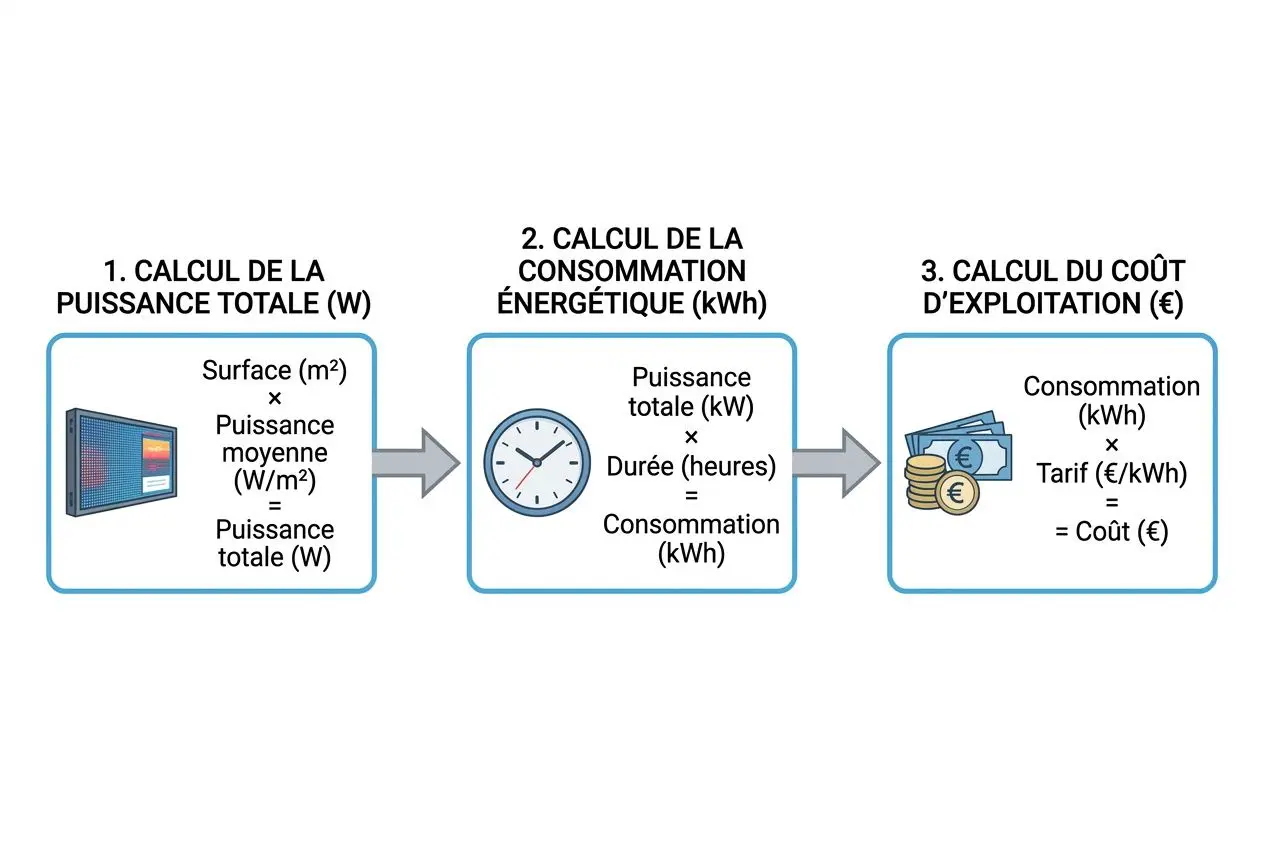
Formulas and Methods for LED Screen Power Calculation
Consumption calculation starts with the electrical power of a screen. The basic formula is straightforward: screen surface (m²) × average consumption (W/m²) = total power (W). Once this power is known, you can calculate kWh consumption by multiplying the average power expressed in kW by the number of operating hours. The cost is then derived from the electricity tariff applied to the site.
- Maximum power: surface (m²) × max power per m² (W/m²). Used to size protections, cables, and the electrical feed.
- Average power: often estimated at around 50% of maximum power in standard video broadcast. This is the most useful baseline for calculating daily consumption.
- Installed power: maximum power increased by 10 to 15% to account for conversion losses, internal distribution, and ancillary equipment.
Current is calculated by dividing power by voltage. For an 8,500 W installation on 380V three-phase, current reaches about 22.4 A—a decisive data point for choosing protections and verifying line capacity. The result depends on existing infrastructure, which is why digitalization of sports venues handles these calculations at the design phase.
Numbered Examples by Screen Size and Usage
LED screen electrical consumption follows screen surface first. At 200 W/m² in regular use, a 3 m² LED screen requires 600 W, while a 10 m² model reaches 2,000 W. Once the installation is finalized, average consumption often drops thanks to broadcast content and automatic brightness adjustment.
In practice, actual consumption frequently sits between 50 and 60% of maximum power. For a 10 m² screen, this generally represents 2 to 4 kWh per hour depending on usage, the white content displayed, and control settings. On the energy side, automatic brightness adjustment and broadcast content choice vary actual consumption by a factor of two.
Transparent LED screens at 90% transparency show 1,600 W or 2,400 W depending on configuration, for brightness between 3,500 and 4,000 cd/m². Conversely, an opaque screen of the same surface may demand more power depending on pitch and target brightness. In real installation, the difference comes from both display technology and the luminance level required by the site.
| Screen Surface | Average Power (W) | Daily Consumption (12h) | Estimated Annual Cost ($0.20/kWh) |
| 3 m² | 600–900 W | 7.2–10.8 kWh | ~ $19 |
| 5 m² | 1,000–1,500 W | 12–18 kWh | ~ $35 |
| 8 m² | 1,600–2,400 W | 19.2–28.8 kWh | ~ $56 |
| 10 m² | 2,000–4,000 W | 24–48 kWh | $150–$300 |
| 30 m² | 6,000–9,000 W | 72–108 kWh | ~ $195 |
Estimated Annual Costs for a Professional Giant LED Screen
At 12 hours per day, a 10 m² video wall represents between 8,760 and 17,520 kWh per year. At $0.20/kWh, the electrical consumption of a 10 m² giant LED screen leads to an annual budget between $150 and $300. This projection helps quantify a long campaign, permanent display, or operating contract with a commitment term.
To calculate screen consumption accurately, it is better to start from average power than from maximum power. In normal use, LED screen consumption is most often between 50 and 60% of the stated maximum. Conversely, using only maximum power to calculate LED screen electrical consumption often doubles the estimated spending.
The logic remains the same for sizing: ignoring maximum power exposes the installation to tripping or premature wear. LED screen electrical consumption, electrical power, and available current must be read together. The difference comes down to integration: a correct calculation reduces gaps between forecast, operation, and actual site capacity.
Do LED Screens Consume More Than Other Technologies?
This question comes up often once a display project gains scale. The larger the surface, the more energy consumption becomes a selection criterion. Yet, at equivalent brightness, an LED screen is leaner than the technologies it replaces: about twice as efficient as a CCFL-backlit LCD, and up to six times less than a plasma screen.
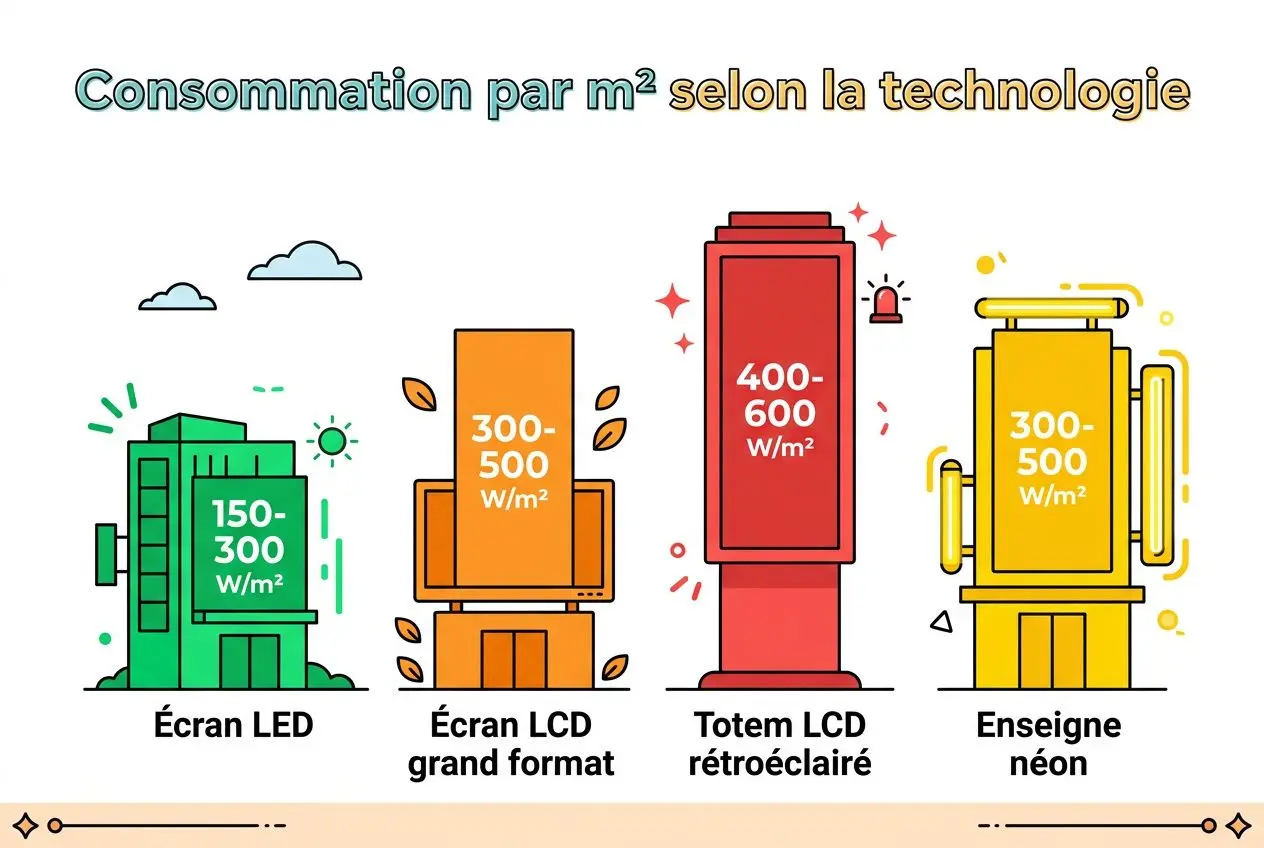
Which Screen Consumes the Least Energy Among Available Technologies
To answer clearly whether LEDs consume a lot, you need to distinguish absolute and relative values. On a large facade, LED energy is visible on the electricity bill. Conversely, at comparable surface and usage, LED consumes less than equivalent solutions. A 55-inch LED screen consumes 80 W, versus 120 W for an identical CCFL LCD—that is 92 kWh per year against 132 kWh per year, for 3 hours of daily use.
ADEME classifications confirm this: most LED screens fall in A+ or A class, while CCFL LCDs are typically B or C. The explanation is technical: LEDs deliver 40 to 50 lm/W, versus 20 to 30 lm/W for CCFLs. In practice, more light is produced for the same energy quantity. Over 5 years, this difference accumulates: brightness can be up to ten times greater and a lifespan beyond 100,000 hours.
- LED screen: 150 to 300 W/m², lifespan > 100,000 hours, ADEME classification A to A+.
- Large-format LCD: 300 to 500 W/m², lifespan ~ 50,000 hours, consumption doubled at equal surface.
- Backlit LCD kiosk: 400 to 600 W/m², lifespan ~ 30,000 hours, preferable only on limited surfaces.
For an advertising screen, this hierarchy quickly shifts the economic balance. LED has replaced neon and LCD in retail and transport, notably thanks to common-cathode technology, which reduces energy consumption by an additional 40%. On a fleet of 10 screens, switching from LCD to LED can generate 3,000 kWh in savings per year—about $550—with a return on investment estimated between 5 and 7 years.
Practical Strategies to Optimize LED Screen Usage
Once the technology is chosen, performance depends on settings. To reduce consumption without degrading the result, lowering brightness by 20 to 30% is often the most effective lever: the savings achieved reach 25 to 40%, with no perceptible visual impact in many contexts. Eco mode adds another 10 to 20%, while ambient light sensors typically contribute an additional 20 to 30% gain. What the eye retains is the balance between readability, environment, and actual display control.
A timer, local dimming, and brightness lowered by 20% can achieve up to 15% cumulative savings, all while preserving components. Content also plays a role: dark backgrounds with light text help reduce consumption, and transparent screens with dark backgrounds can save an additional 25% energy per square meter. Proper ventilation also improves thermal dissipation, supporting energy efficiency without hurting display quality in real installations.
Frequently Asked Questions
What is the electrical consumption of a giant LED screen in professional use?
The electrical consumption of a professional giant LED screen typically ranges between 200 and 400 W per square meter in standard use. At full brightness, power can reach 2,000 W/m²—that is the maximum power to retain for electrical sizing, not for estimating daily spending.
In a simple case, a 10 m² LED screen used 12 hours per day represents an electrical consumption of 24 to 48 kWh per day, or 8,760 to 17,520 kWh per year. Under normal operating conditions, with varied content, the observed average consumption drops to 50 to 60% of this theoretical value.
How to calculate the electrical consumption of a giant LED screen?
To calculate LED screen electrical consumption, start with the surface area. The basic formula is: surface in square meters × average consumption in W/m² = total power in W.
Once this base is set, converting to kWh is simple: average power in kW × duration in hours = electrical consumption. This method allows you to estimate consumption over a day, month, or year, then multiply the result by the electricity tariff to get a coherent usage cost.
To calculate the electrical consumption of a giant LED screen reliably, distinguish average power from maximum power. The first is used to estimate actual energy consumption. The second secures the power supply and cabling, with a 10 to 15% margin.
What levers can reduce the consumption of a giant LED screen?
To reduce consumption, the first lever remains brightness. A 30% decrease can reduce electrical consumption by about 25%, with a limited visual impact once the LED screen operates in an already lit environment.
Next, Eco mode typically provides an additional 10 to 20% in savings. Conversely, ambient light sensors automatically adjust the display and help estimate and manage energy consumption over the year: gains can reach 20 to 30%.
Once the installation is finalized, other settings complete the approach: timer, local dimming, and dark-dominant content. Combined, these choices can reduce screen consumption by an additional 15%, without perceptible degradation of the result.