
From passive aluminum heat sinks to liquid cooling, each method addresses a specific configuration — and the choice directly affects the LED lifespan and luminous flux stability.
LED Cooling Methods: Managing Heat Effectively
An LED converts only 10 to 20% of electrical energy into visible light. The rest becomes heat generated by the junction, with a direct impact on junction temperature and luminous flux stability. For reference on the physics principles relevant to LED sources, the Wikipedia page on air cooling covers the basics of thermal conduction, convection, and radiation.
Why LEDs Need Managed Cooling
LED chips are sensitive to excessive temperature rises. LED cooling methods exist precisely to extract this heat before it accumulates in the substrate and the thermal heat sink.
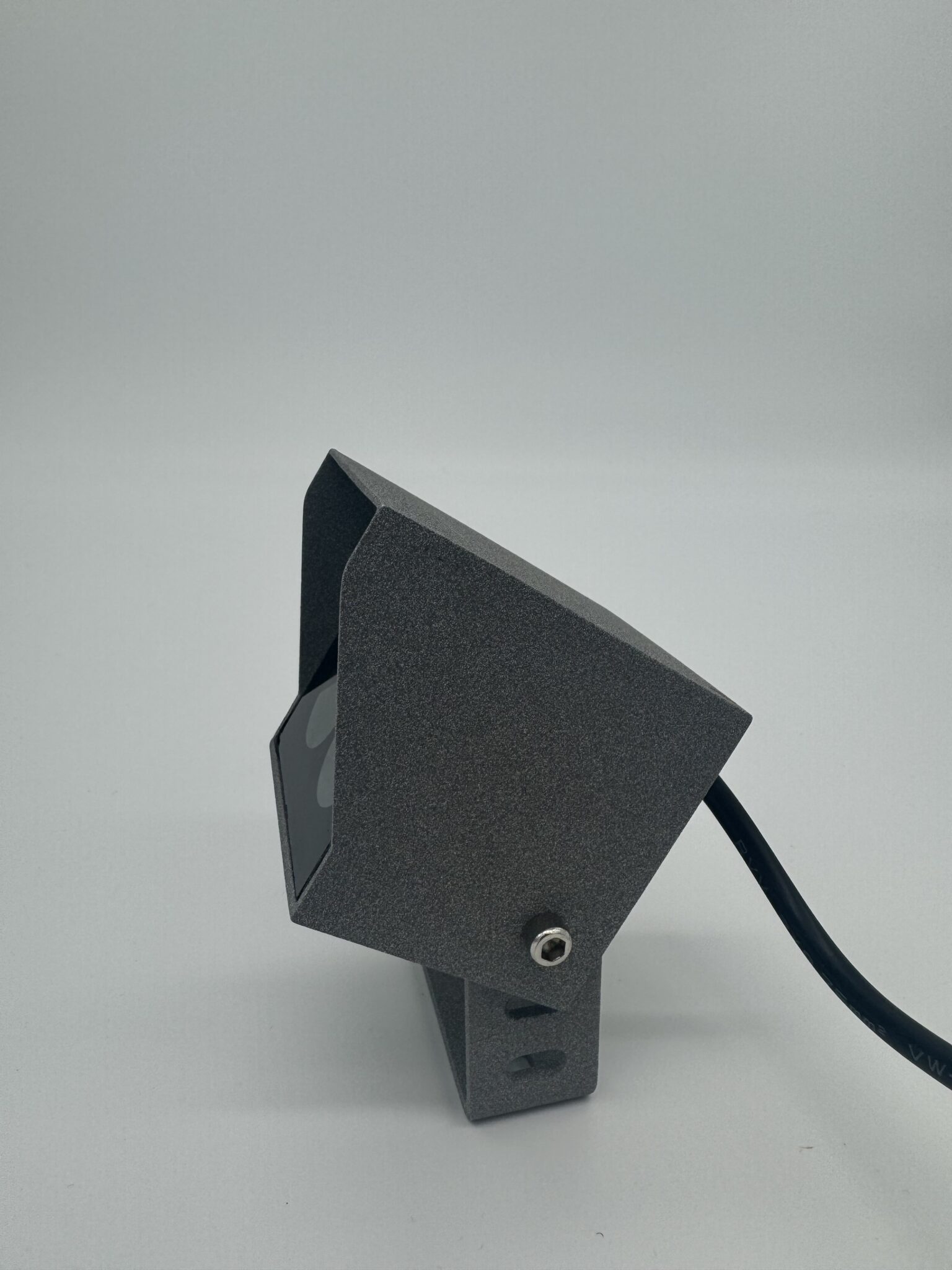
The LED wall washer T4 illustrates this well: its alloy aluminum chassis acts as a heat sink, maintaining a −30°C to 50°C operating range without a fan. Choose this approach when lighting is part of the decor — the unit stays discreet, silent, and thermal dissipation is handled by the structure itself.
- Luminous depreciation: Excessive temperature accelerates flux loss and reduces the perceived efficiency of the installation.
- Chromatic shift: Overheating shifts color rendering and weakens visual consistency across modules.
- Reduced lifespan: Without adequate heat dissipation, reaching 50,000 hours becomes theoretical.
Thermal management of LED lamps therefore requires a holistic view: power, chip density, support material, and available air volume. Once power density per meter increases, cooling systems must be designed from the start — otherwise common LED lamp issues reappear quickly.
Passive Cooling with Heat Sinks, Radiators, and Aluminum Profiles
Passive cooling remains the most common solution, combining reliability, silence, and reduced maintenance. The principle is simple: heat travels from the LED chip to a thermal heat sink, then to ambient air through thermal conduction, natural convection, and (to a lesser extent) radiation. What the eye rarely notices is the radiator — and yet it is what conditions the entire system’s thermal stability.
Within this framework, aluminum profiles play a central role. Their thermal conductivity facilitates heat transfer, while their geometry stabilizes temperature along the length of a strip or module. The COB LED strip in monochrome shows this advantage clearly: with 378 LEDs per meter, heat spreads more evenly across the substrate, limiting hot spots.
- Aluminum thermal conductivity: Alloy aluminum rapidly transfers heat from the source to the heat sink, then to the air.
- Standard aluminum profiles: They serve as both mechanical support and a heat dissipation base, with simple implementation on strips and modules.
- Fins: On a finned heat sink, the exchange surface increases noticeably, improving natural convection in a tangible way.
Contact between the PCB and the radiator is critical. Thermal paste or interface material reduces contact thermal resistance by replacing air pockets — very poor conductors. Without this precaution, the metal’s conductivity alone cannot guarantee adequate heat dissipation.
Active, Liquid, and High-Power LED Cooling Systems
When power density increases, passive cooling reaches its limits. Active cooling adds a fan to the radiator for forced convection: heat extraction becomes faster, temperatures drop further, and system efficiency remains more stable under heavy load. The trade-off is noise, closer maintenance, and an additional failure risk.
For high-power or very compact LED modules, other methods exist. Liquid cooling circulates a heat-transfer fluid against a dedicated thermal heat sink, with excellent heat evacuation capacity. This approach targets dense technical setups, such as the high-density LED cooling on the LEDpulse Cuboid module, which concentrates 24,000 LEDs on just 0.5 cm × 0.5 cm.
Among the more specialized dissipation methods, immersion in dielectric oil is also possible. It provides uniform cooling without a fan, but its complexity, cost, and maintenance requirements limit it to very specific applications. Conversely, a 12 W/m COB strip mounted on aluminum profiles requires no active cooling — a passive heat sink is sufficient if the installation promotes convection.
| Method | Principle | Typical LED application | Advantages | Limitations |
| Passive aluminum heat sink | Conduction + natural convection | COB strips, wall washers | Silent, energy-efficient, reliable | Limited for concentrated high power |
| Active cooling (fan) | Forced convection | High-power LED spotlights | Higher efficiency, thermal control | Noise, initial cost, maintenance |
| Liquid cooling | Water or oil circulation | Very high-density LED modules | Silent, highly performant | Complexity, water-related risks |
| Distributed COB technology | Heat spread across substrate | 378 LED/m COB strips | No hot spots, homogeneous | Limited power per LED |
Optimizing Thermal Management and Preventing Common LED Issues
Good thermal management doesn’t stop at selecting the initial heat sink. Dust deposited on fins hinders convection, increases overall thermal resistance, and progressively degrades cooling efficiency. Regular cleaning with compressed air helps maintain stable performance.
Once the installation is complete, also check the environment: air circulation, enclosure volume, proximity to other heat sources, and radiator orientation. The output depends on thermal stability as much as optical quality. It is at this environmental verification stage that the overall thermal design — heat sink selection, convection management, and heat generation control — reveals its lasting value.
Frequently Asked Questions
What is the best cooling method for LEDs in architectural installations?
In architectural installations, the most coherent choice is generally passive cooling. For COB LED strips, wall washers, or integrated light lines, a properly sized aluminum radiator ensures heat dissipation without a fan or fluid.
Effectiveness comes down to a simple point: the thermal conductivity of the support and the quality of contact with the light source. Once the interface between the PCB and the profile is well-executed — with appropriate paste and low thermal resistance — thermal management remains stable and overheating risk drops significantly.
Active cooling, conversely, only makes sense when power is strongly concentrated in a very compact area: ultra-high-density modules, severe enclosure constraints limiting heat dissipation surface, or high ambient temperatures that reduce the efficiency of a passive radiator.
Why does COB technology improve thermal management of LEDs?
COB technology groups hundreds of LEDs on a single substrate. Heat distributes across a continuous surface rather than concentrating in isolated points, improving thermal management from the design stage.
With 378 LEDs per meter, the FlexLedLight COB strip diffuses heat more homogeneously along its full length. This distribution limits local spikes, reduces thermal resistance, and helps contain overheating when the integration is properly designed.
A more uniform temperature stabilizes light output, preserves color over time, and supports operation compatible with long-term architectural use. The difference comes down to integration: the right profile, a continuous support, and a well-executed thermal interface determine real-world results.
How often should LED heat sinks be cleaned?
Cleaning frequency depends directly on the environment. In a dusty or high-traffic space, quarterly cleaning is prudent; in a clean or controlled technical area, a semi-annual rhythm often suffices.
The watchpoint concerns the fins of the heat sink or radiator: if they accumulate dust, thermal exchange with the air decreases and dissipation becomes less effective. From an optical standpoint, one notices the beam quality; technically, it’s the temperature rise of a partially blocked passive cooling system.
In most cases, a manual air blower or compressed air restores cooling capacity without disassembly. Output depends on the actual state of exchange surfaces: once deposits settle, operating temperature rises faster.