
Illuminating an exterior facade serves three essential objectives: securing access, enhancing architecture, and respecting environmental regulations. Modern exterior lighting effectively combines performance, aesthetics and compliance to magnify your spaces. This guide presents the key criteria, such as selecting outdoor wall sconces and understanding the applicable standards.
What Type of Lighting to Choose for Your Exterior Facade
The nature of your facade, whether residential or heritage, determines the approach to take. Every building requires a subtle balance between light effectiveness and respect for the nighttime environment.
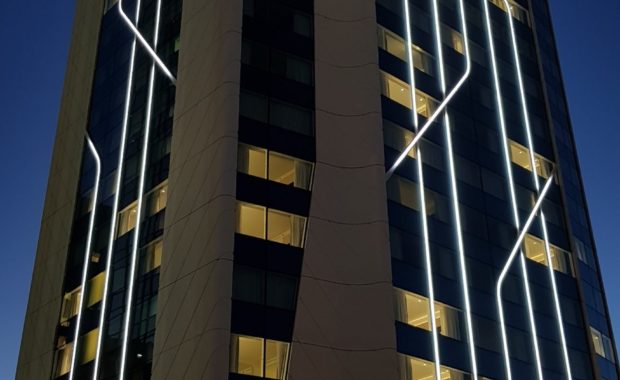
Outdoor LED Architectural Spotlights for Reliefs and Ornaments
The outdoor LED architectural spotlight offers two main light distributions. The narrow beam highlights moldings, while the wide wash ensures even illumination.
- Narrow beam 10°: Enhances cornices and pillars by creating elegant shadow plays.
- Linear wash 30–45°: Uniformly illuminates flat surfaces without unsightly shadow patches.
- Optimal positioning: Install them one meter from the wall for perfect diffusion.
- Controlled power: Budget 8 to 12 W/m² to avoid glare and protect the night sky.
It is essential to keep upward light emission below 1% to protect wildlife. Matte finishes ensure harmonious integration, while anodized materials effectively resist marine environments.
LED Interior Exterior Architecture and DMX Bars for Dynamic Facades
LED interior exterior architecture integrates programmable bars for automated light shows. With high pixel density, these systems guarantee smooth transitions, ideal for hotels.
These bars dynamize buildings by syncing with events or specific schedules. Remote control via smartphone allows easy adjustment of consumption during off-peak hours.
| Luminaire type | Beam | Power | Ideal application | ULR compliance |
| Narrow spotlight | 10° | 12–18W | Reliefs, ornaments, moldings | <1% upward |
| Linear wash bar | 30–45° | 24–36W | Flat facades, large surfaces | <1% upward |
| DMX RGBW bar | 30–45° | 36–48W | Commercial facades, animations | <1% upward |
| Indirect wall sconce | Wide diffusion | 8–20W | Residential entries, pathways | <4% measured on-site |
Essential Technical Standards: IP Rating, Power, Color Temperature
The protection rating guarantees resistance to water and dust. An IP65 rating is generally sufficient, but a higher rating is needed near the coast.
Facade lighting regulations set the maximum color temperature at 3000K for non-residential sites. This preserves biodiversity while faithfully restoring the natural colors of materials.
- IP65 rating: Standard protection ideal for everyday use.
- IP66-IP67 rating: Essential for difficult mountain or coastal zones.
- Very warm white (2700K): Perfect for a cozy and welcoming atmosphere.
- Warm white (3000K): The legal standard for gentle enhancement.
- Neutral white (4000K): Ideal for highlighting contemporary architecture.
Well-calibrated lighting prevents neighbor glare while ensuring safety. In addition, high-performance modules reduce energy bills and offer exceptional lifespan.
Outdoor Wall Sconces: Design, Materials and Architectural Integration
Available models intelligently combine aesthetic design with nighttime efficiency. A photometric study allows precise adaptation of each exterior wall light to the specific site configuration.
Facade lighting regulations first and foremost require durable, non-corrosive materials. Black aluminum or brushed stainless steel bring a contemporary touch highly appreciated in urban settings.
- LED outdoor sconces: Sleek lines to adapt to every architectural style.
- Wall-mounted lights: They diffuse a soft, welcoming light without glare.
- Recessed profiles: Discreet, they blend into the structure for an invisible effect.
- Visual symmetry: Regular placement guarantees a harmonious nighttime aesthetic.
Dual-beam models create a welcoming ambiance while securing access.
Motion Sensing and Smart Automation
Integrating a motion sensor limits energy waste through activation only on demand. The timer adjusts easily to avoid abrupt cut-offs in high-traffic areas.
A dusk-to-dawn sensor automates lighting at twilight. A color and brightness switch additionally offers the ability to modify the ambiance without reprogramming the entire system.
- Infrared sensor: Responsive and ideal for main entrances.
- Ultrasonic sensor: Detects through obstacles with long range.
- Dusk sensor: Automatically manages lighting based on ambient light.
- Timer: Enables significant energy savings.
Centralized systems allow multiple independent zones to be controlled. You can thus adjust your exterior lighting from a smartphone according to your needs.
Regulatory Compliance and Light Pollution Reduction
Current laws impose strict rules to protect nighttime biodiversity. Shutdown must generally occur no later than 1 AM.
It is mandatory to limit upward light emission to meet standards. Additionally, luminance must remain moderate to avoid disturbing neighbors.
- Minimal emission: Effectively protects migratory birds and local wildlife.
- Optimal orientation: Deflectors prevent light from bothering neighboring properties.
- Time management: Programmable timers automatically switch off lights late at night.
- Warm light: A soft hue attracts fewer nuisance insects.
Non-compliance with these rules can lead to significant financial penalties. Always check technical sheets to guarantee the compliance of your installations.
Custom Solutions and Durable Maintenance
A lighting project begins with a detailed analysis of the facade. Components that are easily removable then ensure straightforward long-term maintenance.
Complete support includes installation, aesthetic advice and regular follow-up. A well-chosen outdoor LED wall light will become an architectural signature for your building.
- 3D modeling: Allows visualizing the final result before construction.
- Test phase: Validate the lighting effect on-site with a prototype.
- Simplified maintenance: Quick connectors facilitate future repairs.
- Technical follow-up: Regular cleaning ensures the longevity of the installation.
The choice of an LED wall light or ceiling light is refined through three-dimensional simulations. An outdoor ceiling light is ideal for effectively illuminating a covered pedestrian walkway.
Flexledlight Product Range for Residential Facades
An round LED wall light or square LED wall light naturally integrates into your architecture. An 3x3W LED wall light suffices for a garage door, while a 9W LED wall light perfectly illuminates an entrance. For larger surfaces, opt for a 13W LED wall light or a 13.5W LED wall light.
The 20W IP65 indirect LED and 40W IP65 indirect LED diffuse a soft light ideal for numerous projects. For unique character, an outdoor decorative wall light adapts to traditional regional styles.
- Circular design: Soft lines for very discreet integration.
- Cubic lines: Perfect for highlighting modern and geometric architecture.
- Polycarbonate outdoor wall light: Ultra-resistant to impacts and guaranteed waterproof.
- Double LED sconces: They elegantly frame your main entry doors.
The 8–20W IP65 waterproof LED range is perfect for more modest budgets. An indirect LED wall light or an outdoor double LED wall light creates a warm ambiance while maximizing safety. An asymmetric outdoor double LED wall light reduces glare for passersby.
An LED wall light concentrates the beam downward to avoid neighbor disputes. Finally, a black matte square outdoor wall light accentuates wall textures with striking contrast. Moreover, a quality outdoor LED or a standard IP65 indirect LED wall light beautifies housing durably.
Practical Cases and Reference Projects
Several international hotels use programmable lighting to create economical nighttime animations. Parisian shops also combine transparent screens with subtle indirect lighting.
In the residential sector, low-power fixtures paired with detectors ensure comfort and safety. On textured stone walls in the mountains, grazing light reveals the authenticity of natural stone.
- Proven efficiency: New technologies consume far less than halogen.
- Material respect: Light enhances textures without distorting them.
- Standards met: Each project guarantees very low light pollution.
- Smart management: Automation greatly reduces manual interventions.
Some shopping centers animate their storefronts by modulating light intensity based on foot traffic. These projects prove that it is possible to combine aesthetics, cutting-edge technology and strict compliance with environmental regulations.
Frequently Asked Questions
How to properly light the facade of my residential home?
To successfully achieve your exterior lighting, certain key points are essential to consider. Budget an appropriate power of 8 to 12 W/m² and a color temperature between 2700 and 3000K to create a warm ambiance.
Your exterior wall lights must have a minimum IP65 protection to withstand the elements. Position your LED exterior wall lights approximately every meter to avoid undesirable shadow areas. Generally, a light output between 3000 and 5000 lumens is sufficient to illuminate a standard facade.
Always orient your spotlights downward, ideally with deflectors, to reduce light pollution. A dusk sensor paired with a motion detector allows automated on/off without human intervention. Finally, a color rendering index above 80 guarantees beautiful enhancement of your facade materials.
What standards to follow for a legal exterior facade lighting installation?
The December 27, 2018 order strictly regulates exterior lighting installations. Lighting must occur after sunset and shut off before 1 AM. The maximum permitted color temperature is set at 3000K.
The IP65 protection rating is mandatory to ensure good rain resistance. In coastal or mountain zones, more robust IP66 or IP67 rated equipment is recommended. The proportion of light directed upward must remain below 1%.
It is important to limit luminance to 0.5 cd/m² to avoid blinding neighbors. Before any purchase, check product compliance on the manufacturer’s technical sheet. In case of non-compliance, you risk a fine of up to €1500.
What is the difference between an architectural spotlight and a wall-mounted light for facades?
The architectural spotlight diffuses continuous vertical light, ideal for large commercial facades. It highlights cornices and architectural details. Conversely, an LED wall light is more discreet and perfect for residential entrances.
LED exterior wall lights adapt easily to your home thanks to their many geometric shapes. An indirect LED wall light directs beams toward walls for a soft, warm effect. This type of indirect lighting offers a welcoming ambiance without risk of glare.