
A giant LED screen for a shopping mall that is improperly sized can lose up to 40% of its readability in the first year of operation. This loss is not due to a technical defect, but to a pixel pitch unsuitable for the actual viewing distance in your space. In practice, validating luminous intensity and electrical sizing before signing the quote securely your investment long-term.
LED Screen Technologies for Shopping Malls
The market divides LED display into two precise technical categories: opaque modules and transparent panels offering up to 90% light transmission. Each architecture responds to specific thermal and structural constraints in your spaces. The difference lies in heat dissipation calculations, well before any gallery installation.
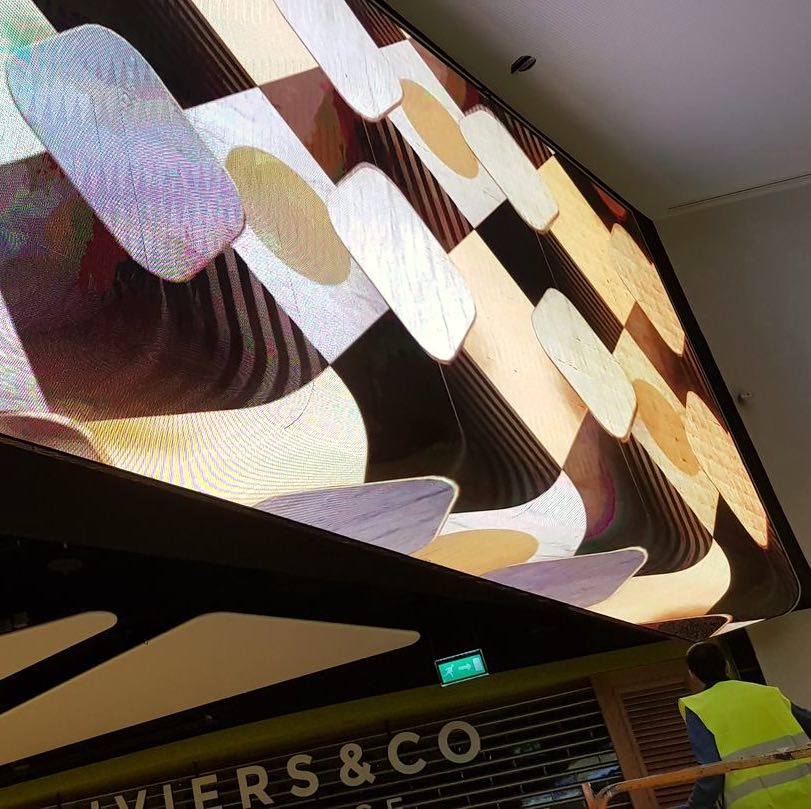
COB vs SMD: Which Choice for an Interior LED Screen?
For configuring an interior LED screen for shopping malls, the choice between COB and SMD technology immediately sets your five-year maintenance budgets. The COB standard of a LED screen for shopping malls offers ideal black depth for a premium zone. In practice, SMD technology allows replacing a faulty component without heavy tools.
- COB: absolute contrast: LEDs encapsulated on the board ensure strict visual uniformity, to be preferred when visitors are within one meter.
- SMD: practical brightness: surface-mounted components deliver strong luminous flux and simplify local interventions, reducing initial material cost by about 20%.
- Certified longevity: both interior LED screen standards guarantee 100,000 hours of operation, i.e. fifteen years of continuous activation in a retail space.
At FlexLedLight, we prefer SMD architecture for high-traffic areas requiring quick maintenance. COB mounting is fully justified in a closed showroom or a very high-end storefront. What distinguishes the two approaches is primarily the rear technical accessibility of your supporting structure.
Brightness and pitch according to viewing distance
In practice, giant LED screens deployed indoors require a strict luminosity range between 800 and 1,500 nits. A lower level fades under gallery lighting, while higher flux causes eye strain. Always include a gradation sensor to adjust this parameter in real time.
Pixel density determines the sharpness of the giant screen relative to your audience’s observation position. Targeting an extreme pitch for dynamic LED display overhead wastes budget without measurable visual improvement. The decision comes down to the actual installation distance, not a spec sheet read out of context.
| Viewing distance | Recommended pitch | Typical application |
| 0.5 – 1 m | P1.5 max | Hotel lobby, proximity storefront |
| 1 – 2 m | P1.5 – P1.9 | Retail spaces, gallery shops |
| 2 – 4 m | P1.9 – P2.6 | Storefronts, small indoor facades |
| 4 m and more | P2.6 – P4.8 | Large halls, outdoor facades |
Design and architectural integration of giant screens
Equipment without visible chassis integrates into your architectural lines without breaking the perspective of volumes. This technical approach reassures local brands that require impeccable visual communication integration. A LED panel mounted flush with the wall ensures a sharp finish while protecting components from frontal impacts.
Concretely, a properly sized LED video wall mechanically captures the attention of shopping mall visitors with significantly higher conversion efficiency than printed media. In my view, this conversion lever in retail spaces justifies investing in a giant LED screen for any storefront or high-traffic area. Always verify the load capacity of your wall before validating the final placement.
Storefront and Giant Screen Size for Every Space
Precise sizing of a giant screen determines the pitch to retain and the electrical envelope of the project. In practice, a 250 m² central hall does not face the same structural constraints as a 4‑meter storefront. Your installation calculation starts with rigorously measuring the wall to be equipped, not consulting a standard catalogue.
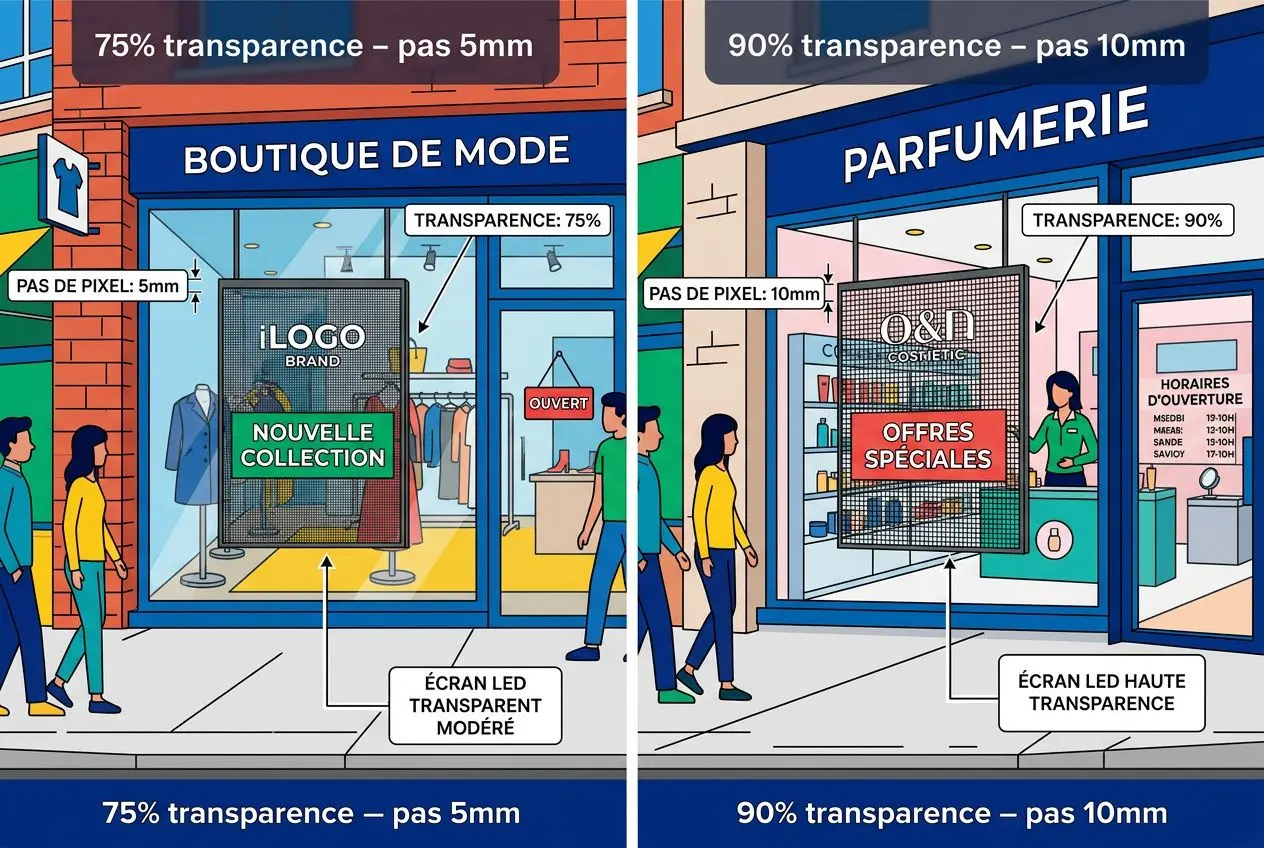
Transparent screens for store storefronts
Concretely, a giant LED storefront screen at 90% transparency relies on SMD 2020 technology to deliver up to 4,000 cd/m². The visual displays as an overlay without obstructing natural light entering through your storefront. We recommend 75% transparency on 960 x 400 mm modules to guarantee text readability at 2 meters. The 90% option, with a 10 mm pitch, is better suited for large bay windows.
Since the monumental installation at Les 4 Temps in 2013, this format’s robustness is documented. You can consult the real characteristics in the report dedicated to this reference giant LED screen.
Choosing the right LED giant screen size
LED store screen size dictates the number of panels needed and the pixel pitch suited to your reading distance. Below 4 linear meters, a density of 10,000 pixels per square meter suffices for a storefront. Beyond this dimension, I recommend stepping up to 16,000 pixels to avoid the grid effect.
In practice, integration occurs in wall-mounted, suspended, or freestanding configuration depending on your premises layout. Weight ranges from 80 to 400 kg depending on the chassis selected. The difference comes down to analyzing the load-bearing capacity of your ceiling, a point to validate before any order.
- Compact format (few m²): this size requires P1.5 to P2.6 pitch and standard wall mounting, suited to a retail shop.
- Intermediate format (10 to 50 m²): we use reinforced framing, with mandatory verification of attachment points.
- Large format (50 m² and above): integrating a large-format LED screen requires a rigorous engineering study to control heat dissipation.
On the power supply side, a transparent LED consumes 30% less than an opaque panel of equivalent surface area. Average power stabilizes around 200 W/m², against peaks exceeding 1,000 W/m² on older systems. In my view, this is the decisive technical argument for reducing your electrical footprint long-term.
Giant LED Screens for Advertising Communication
In practice, a giant LED screen for shopping malls updates its broadcast feeds in under two minutes via an embedded connection. This minimal latency guarantees reactivity within the shopping mall, without requiring physical intervention on the chassis. Digital communication thus takes over from physical print, securing information across the entire site.
Programmable LED advertising panel and content management
Concretely, a LED advertising screen interfaces directly with the cloud, significantly reducing on-site IT equipment. Automatic brightness adjustment autonomously compensates for seasonal lighting variations. This precise parameterization guarantees the durability of your LED display against environmental changes.
- Instant updates: your advertising content switches remotely in seconds, eliminating the need for an on-site technician.
- Schedule programming: granular management by day or hour optimizes the impact of your advertising messages.
- Per-screen personalization: spatial targeting allows each module to display a distinct feed based on its implantation zone.
- Automatic brightness adjustment: built-in sensors stabilize dynamic LED display while strictly managing the panel’s electrical consumption.
In practice, LED technology delivers a luminous flux at least 4 to 5 times higher than traditional LCD panels. It is this intensity reserve, not raw resolution, that secures readability under very exposed glass canopies. I consistently prefer this technical approach for dealing with reflections in complex commercial environments.
Using a programmable LED advertising panel centralizes directional guidance and punctual public information. The visual communication delivered by these devices rationalizes the number of giant LED screens deployed in major circulation aisles. This functional pooling reduces the annual maintenance burden of the infrastructure.
Impact and potential of advertising LED screens in a mall
A major commercial hub regularly processes flows exceeding 40 million annual visits. Placing an advertising giant LED screen at the heart of these circulation axes ensures particularly effective audience capture. A giant screen positioned strategically transforms this foot traffic volume into concrete impulse purchases for surrounding brands.
The relevance of advertising LED screens lies in their ability to integrate the message into the overall architectural environment. These supports assimilate without triggering the rejection phenomenon typical of traditional printed media. The difference truly comes down to this qualitative and modern perception of the space.
LED outdoor vs indoor for commerce advertising
An outdoor LED screen requires a baseline of 5,000 nits to compensate for direct sunlight on the front face. Conversely, a standard indoor LED screen is generally calibrated between 800 and 1,500 nits depending on the project. This technical leap between outdoor LED and indoor LED dictates the entire thermal study of the system.
- LED indoor: luminous range of 800 to 1,500 nits with magnetic front maintenance, ideal for designing an indoor screen accessible in any LED indoor context.
- LED outdoor: minimum IP65 waterproofing and enhanced thermal resistance, strict criteria to ensure continuous operation of each giant screen on a facade.
- Storefront: mechanical transparency maintained up to 90%, forming the ideal architectural bridge between outdoor constraints and indoor LED screen usage.
To equip a north-facing glass facade, a 90% transparent mesh preserves the building’s natural light contribution. For full south exposure, our position at FlexLedLight requires validating a peak of 4,000 cd/m² during the photometric study. Always verify this margin before committing to final installation works.
Installation, Costs, and Giant Screen Maintenance
Between order and commissioning of an indoor giant LED screen, expect an average of eight weeks. This timeline covers the manufacturing of LED panels, transport to the site, and final colorimetric calibration.
In practice, anticipating this schedule avoids any delay during a shopping mall opening. The difference precisely comes down to the rigor of planning on-site operations.
Key installation steps for giant LED screens
The installation of a giant LED screen requires at least two technicians. Giant LED screens assemble via precision hook mechanisms before any cabling, to prevent structural defects.
- Unpacking and verification: a visual inspection of each module immediately identifies manufacturing defects.
- Mechanical assembly: millimeter alignment guarantees uniformity of the final LED screen panel.
- Structured cabling: respecting the factory diagram prevents dead zones and display desynchronization.
In practice, elevated installations require certified beams and appropriate safety cables. The rear technical space must remain accessible to allow component replacement without dismantling the entire structure. Allow at least 60 cm clearance behind the chassis.
Electrical consumption and cost optimization
The consumption of an LED screen of 10 m² ranges between 2 and 4 kWh/h in normal operation. These real values remain below the theoretical maximums advertised by manufacturers. What distinguishes a well-sized project from another is precisely accounting for these real figures from the electrical study phase onward.
- Eco mode: reducing brightness by 30% lowers electrical consumption by about 25%.
- Ambient sensors: adjusting power according to ambient lighting generates up to 40% annual savings.
- Dark-toned content: a black background reduces consumption by 15 to 20% during advertising content broadcasting.
- Common Cathode architecture: extends component lifespan while reducing overall energy demand.
Combined, these methods generate measurable savings over a full year of operation. At equivalent brightness, LED technology surpasses LCD in thermal efficiency. Always demand an electrical study before validating your quote.
Calibration, maintenance, and equipment lifespan
Colorimetric calibration occurs on the mounted frame, before any media broadcast. A brightness between 600 and 1,500 nits suits indoor giant screens, depending on the specific conditions of your LED indoor installation. A precise initial setting prevents both glare and dull spots.
Maintenance occurs from the front using magnetized modules. Concretely, replacing a faulty component takes less than an hour. In my view, the quality of ventilation, more so than the diodes themselves, conditions the longevity of your display.
At FlexLedLight, we prioritize thermal reliability above all other criteria. Our range of giant LED screens covers opaque models up to 90% transparent panels. For an outdoor screen or an indoor giant screen operated over three years, we recommend Common Cathode architecture: this technical choice secures your investment throughout your commercial lease.
Frequently Asked Questions
What is the price of a giant LED screen for a shopping mall?
The budget for a giant screen in SMD interior technology ranges between €1,500 and €4,500 per square meter. Concretely, a giant LED panel of 10 m² at P2.6 represents an investment of €15,000 to €25,000, installation not included. Integration into a shopping mall invariably requires a structural study, as cabling and mounting height redefine the overall budget envelope.
What LED screen size to choose for a shopping mall?
The primary viewing distance determines the required resolution, well before the available wall area. For foot traffic at 3 meters, a giant LED screen of 6 to 12 m² at P2.6 suffices to effectively attract attention. Beyond 10 meters of setback, a large screen of 50 m² at P4.8 guarantees quality LED display, without unnecessarily multiplying pixel count.
Interior or exterior giant LED screen for a shopping mall?
An LED indoor module deploys between 800 and 1,500 nits, against minimum 5,000 nits for an outdoor LED screen positioned behind a storefront exposed to sunlight. The difference comes down to the on-site light measurement: it is this reading that dictates the choice of LED panel and format before installing a giant LED screen permanently. In practice, advertising LED screens configured for outdoor use in transparent format reduce thermal consumption by 30%, securing the installation throughout the lease duration.