
A giant 3D screen without glasses requires, first and foremost, a refresh rate of at least 3,840 Hz outdoors. The electrical sizing, pixel pitch selection, and L‑shape angle calibration determine the success of this installation. Every technical parameter directly conditions the long-term stability of the video wall.
How a Giant 3D Outdoor Screen Works
The depth of a LED screen never results from software post-processing. Panel physics comes into play right from the optical design of the modules, precisely steering the light. It is this material distinction that separates a genuine 3D display from a degraded illusion in a shop window.
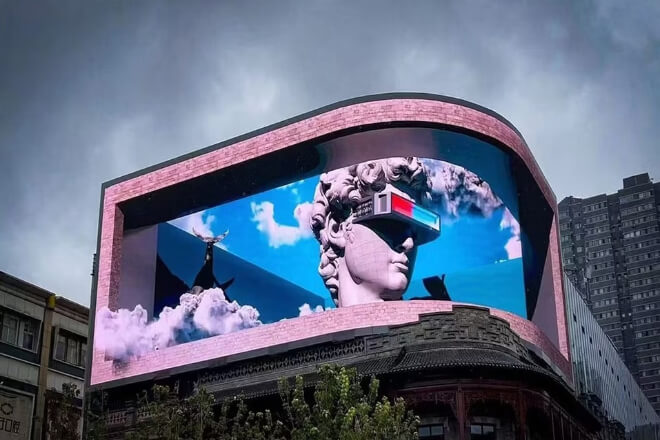
Autostereoscopic Technology and Depth Effect
The recurring question of “what is a 3D LED screen” calls for a rigorous definition. An LED 3D screen with autostereoscopic technology sends a distinct image stream to each eye through a millimetric vertical division. The viewer’s brain then fuses this data to perceive tangible geometric depth.
- Optical division: Micro-mirrors calibrate the direction of light according to your viewing angle. This mechanical offset generates the volume.
- Scanning frequency: A rate above 3,840 Hz practically eliminates visual artifacts. This standard ensures clean smartphone video capture.
- Shared field: Multiple observers capture the simulated stereoscopy simultaneously, with no ocular constraint. This point maximizes effectiveness in pedestrian areas.
By comparison, a classic IMAX 3D screen requires two perfectly synchronized projectors. The autostereoscopic panel removes this constraint by integrating optical separation directly into the components. The difference lies in total hardware autonomy.
L‑shape Configuration and Face Synchronization
In practice, the technical operation of giant LED screens at a corner requires a 90 degree mechanical joint with no visual break. A single controller manages both panels with sub-millisecond latency. This electronic rigor preserves perspective in its entirety.
The video content requires calculation based on a single focal point, defined from the precise dimensions of the structure. A generic file not adapted to the local geometry systematically destroys the anamorphosis. This is the typical failure encountered with inexperienced suppliers.
Technical Specifications of 3D LED Panels
In practice, a giant 3D screen outdoors uses pitches from 4 to 10 mm. Brightness, measured between 4,500 and 10,000 cd/m², ensures contrast in full sunlight. IP-rated CMS pixels guarantee the system integrity against the elements.
- Pitch and viewing distance: A 10 mm pitch is suitable for observation between 10 and 300 meters. Reducing this value without justification inflates the budget with no noticeable visual gain.
- Structural topology: Modules adapt to flat or angular surfaces while concealing frames. Integrating a flexible LED panel efficiently handles complex architectural curves.
- Climate protection: IP65 rating remains essential to secure circuits outdoors. This standard blocks dust and tolerates direct water projection.
In my view, a 6.67 mm pitch is the right choice for a facade viewed from 15 to 50 meters. Below that threshold, step up to P4 for clarity. Beyond 50 meters, an 8 or 10 mm matrix reduces cost without compromising output.
Advantages of Giant 3D LED Screens for Outdoors
A giant screen designed to display 3D images outdoors requires a minimum brightness of 6,000 nits per square meter to compete with natural light. In practice, this technical requirement radically distinguishes our current installations from the domestic stereoscopy of the 2010s. It is precisely this power difference that makes the LED screen a viable and durable solution for urban advertising.
Does Glasses-Free 3D Replace Old 3D TVs?
Among the giant LED screen advantages, the absence of equipment on the observer remains the central argument in any project study. The viewer perceives depth naturally as soon as they enter the vision axis of the installation. This is precisely the constraint-free operation that domestic TVs could not reproduce back then.
- Abandonment of mainstream TVs: Historical manufacturers ended their 3D ranges between 2016 and 2017, due to the hardware constraints imposed on users.
- Glasses-free 3D technology for public space: The current glasses-free 3D technology relies on spatial multiplexing, a method unsuited to private spaces but mechanically optimized for large facades.
- Calibrated viewing angle: A horizontal viewing angle of 160 degrees ensures 3D stability for an entire dispersed pedestrian flow.
Today deployed glasses-free 3D is not a simple update of the old living-room offering. The transition from LCD panel to LED component modifies the very architecture of urban 3D display. For your specifications, prioritize the aperture ratio and pitch over nominal resolution alone.
Practically, an LED 3D screen calibrated for a south-facing exposure maintains contrast up to 10,000 nits. This value secures content readability under direct sunlight, a critical validation point for any project.
Visual Performance and Impact on the Audience
The question “are 3D TVs still made” frequently comes up during pre-design meetings. In practice, these products have disappeared from standard distribution, replaced in a parallel market by the giant LED screen in 3D display. This sector now relies on autostereoscopic matrices and very high-capacity video processors.
The embedded colorimetric processing generally covers 95% of the DCI-P3 spectrum, with a physical contrast reaching 5,000:1. This deep black, generated by absorbing diode masks, is what detaches image elements from each other. Verify the colorimetric calibration capability of your processors before validating the network infrastructure.
| Technical parameter | Old domestic 3D TV | Giant outdoor LED 3D screen |
| Peak brightness | 400 to 600 nits | 4,500 to 10,000 cd/m² |
| Peripheral filter | Yes (polarized or active glasses) | No (native autostereoscopy) |
| Contrast ratio | Up to 1,000:1 | Up to 5,000:1 |
| Coverage angle | Strict frontal axis, fixed position | 160/160, wide pedestrian sweep |
| Environment | Controlled indoor | Urban environment, harsh conditions |
| Commercial cycle | Production discontinued (2016–2017) | Active urban and architectural deployment |
Durability, Lifespan and Return on Investment
An outdoor LED screen assembled on pressure-cast aluminum frames maintains its alignment beyond 100,000 hours of use. This physical stability prevents pixel drift between sessions, the primary factor of visual degradation on a video wall. In my view, the rigidity of the supporting structure directly determines the long-term stability of the three-dimensional illusion.
In practice, power consumption drops by 30% on recent panels equipped with low-voltage receiver cards. This efficiency limits internal heat buildup and protects electronics against premature wear. To secure the depreciation schedule of your equipment, request a quantified thermal dissipation plan before any module order.
Use Cases, Content and Outdoor Installation
The lifespan of an LED display 3D outdoor system is 80% dependent on the preliminary technical preparation. In practice, this type of infrastructure tolerates no approximations, whether structural or visual. The consistency between the location, the content and the reading distance determines the project long-term stability.
Advertising Applications and Strategic Placements
Anamorphic 3D content requires a clear line of sight of 20 to 50 meters to correctly restore perspective. Practically, audio-visual launches leverage this focal distance to maximize message reach. It is this rigorous calculation that enables capturing attention in a saturated urban environment.
A correctly positioned giant 3D screen installation generates organic advertising that no classic media plan can match. The visual impact is measured directly by the volume of spontaneous social media shares.
- Pedestrian plazas and commercial corners: These zones concentrate the traffic of every potential viewer. This placement choice is especially suited for campaigns focused on luxury and technology.
- High-end flagships: A giant screen installed in a storefront increases foot traffic by approximately 15%. This documented figure fully justifies the investment on heavily trafficked thoroughfares.
- Professional trade shows: Loops of 8 to 12 seconds suffice to anchor a brand identity. This short format energizes the booth without tiring passersby.
V‑angle formats like those at Times Square, reaching 30 by 20 meters, define the international standard in immersion. The media impact of these structures is regularly multiplied fivefold. The difference comes down to perspective calibration, far more than the raw dimensions of the giant LED screen.
Anamorphic 3D Content Production in 15 Days
Delivery of a sequence for a giant outdoor LED screen installation requires precisely fifteen working days of post-production. The process includes five mandatory steps, from the initial concept to final encoding. The delivered file uses an MP4 format or PNG sequence, with a minimum of 1,920 × 1,080 pixels per face to guarantee sharpness.
The 3D content calculation integrates the physical junction angle and the ideal viewpoint position. Without this precise geometric adjustment, the illusion collapses immediately, regardless of the hardware resolution. Your existing brand assets are reconstructed according to the strict visual tolerances this digital medium demands.
Technical Installation and Optimal Viewing Conditions
The installation of a LED module of this scale systematically mobilizes two qualified technicians to handle each panel safely. The LED screen cabling follows a specific routing to ensure perfect synchronization of data streams. Any deviation from the original electrical diagram generates dead zones that no software reconfiguration can correct.
A 3D screen configured as a giant curved unit endures continuous thermal and mechanical stress. Its assembly relies on fixings designed to absorb these variations without compromising the building facade. Factory load tests prevent the need for costly on-site rework.
The ideal viewing distance to ensure 3D effect legibility equals three times the height of the equipment. Beyond this distance, the effect remains coherent, securing message comprehension by passersby. Once the device is mounted, brightness requires luxmeter calibration according to the site actual solar exposure.
The overall chassis design influences final output as much as the video itself. At FlexLedLight, we factor this physical constraint into the first budget study to avoid any unpleasant surprises. The chosen solution systematically includes a focal point calculation based on the exact topography of your premises.
Frequently Asked Questions
Are 3D TVs Still Available?
The answer is clear: mainstream production definitively ceased around 2017. The rejection of mandatory accessories, combined with a lack of adapted content, killed this market. In practice, 3D display is experiencing a technical renaissance today, driven by the giant screen designed for outdoor use. If you are looking for glasses-free 3D, the solution lies exclusively in professional urban architectures.
What Budget for a Giant Outdoor LED 3D Screen?
Practically, a giant LED screen installation configured at a right angle requires a rigorous structural study and certified IP65 cabling. What distinguishes this approach from a standard LED display is the requirement for custom-calculated anamorphic content. Expect a technical premium of 15 to 25% for an LED 3D screen of this type. This choice is financially justified as soon as the installation runs continuously for more than three years.
What Is the Ideal Viewing Distance for a Glasses-Free 3D Screen?
In practice, the optimal viewing axis corresponds precisely to three times the height of your LED screen. Below this limit, depth perception degrades rapidly and the volumetric illusion fragments. On a properly calibrated 3D screen, this perspective remains readable and stable for observers positioned beyond this focal reference zone.