
This article clarifies the technical differences between an LED screen and classic LCD or OLED displays to help guide your next purchase or professional installation project. It explains how LED backlighting, energy consumption, and image quality influence a successful display—a decisive factor for any visual communication strategy in storefronts or on building facades.
What Is the Difference Between LED Backlight and LCD?
A consumer “LED screen” is, first and foremost, a liquid crystal display (LCD); the distinction lies in its backlight. Here, light-emitting diodes (LEDs) serve to illuminate from behind liquid crystals that make up the pixels, whereas in professional LED displays the LEDs themselves are the pixels and emit colored light (RGB).
This shift in light source changes brightness, contrast, black depth, durability, and energy consumption.
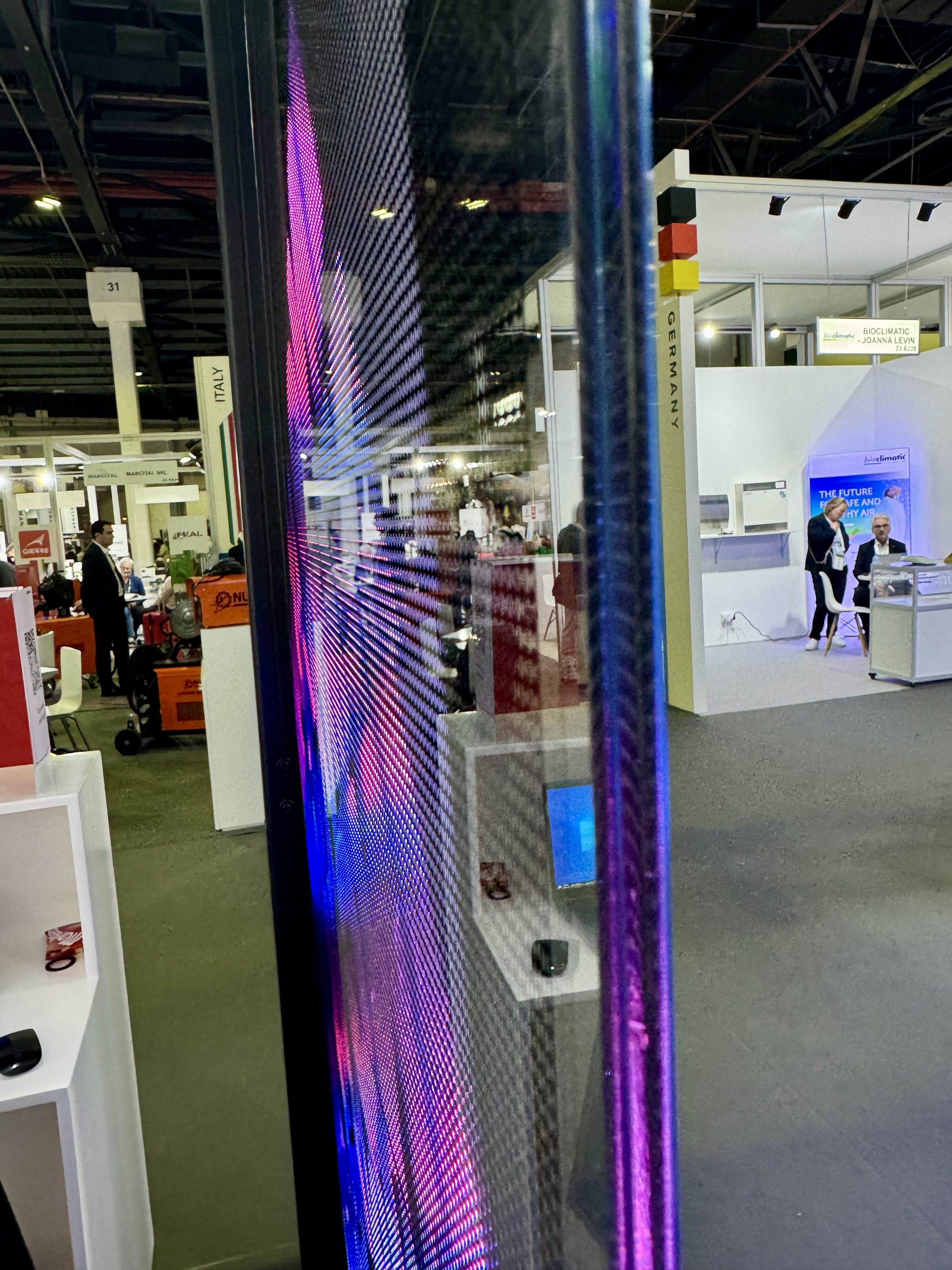
Backlight Architecture and How It Works
Two approaches dominate LED backlighting in LCD screens. The Edge-Lit model places diodes along the panel edge, enabling an ultra-thin and lightweight design. The Full-Array system, meanwhile, scatters diodes across the entire rear surface and allows local dimming to optimize contrast, image quality, and color gamut.
- Edge-Lit Architecture: Diodes placed around the perimeter for an ultra-thin panel, ideal for smartphones or slim wall-mounted televisions.
- Full-Array Technology: Diodes distributed evenly behind the surface, providing precise zonal control and remarkable black depth for commercial display.
- Local Dimming Functionality: Each zone brightens or darkens independently, eliminating the light halo often produced by classic LCD screens with CCFL backlighting.
A 55-inch LED TV typically houses 4,000 to 6,000 diodes, compared to one or two lamps in a traditional CCFL LCD. This lighting density revolutionizes light control and expands the available dynamic range, producing impressive black depth and markedly superior contrast.
The transition from CCFL tubes to LED backlighting has also drastically thinned panels. Today, curved displays and wall mounts just a few centimeters thick have appeared.
Local Dimming and Brightness Control
Thanks to local dimming, light varies by zone: a deep night sky can sit beside a brightly lit building without compromise. Classic LCDs, illuminated uniformly, turn those blacks to gray, limiting contrast and visual fidelity.
This zonal modulation dampens the halo effect observed on many CCFL panels. By controlling each diode, FlexLedLight achieves a crystal-clear render, subtle gradients, and better energy consumption—qualities essential for any display of quality.
Impact on Contrast and Image Quality
Contrast, measured between the brightest point and the darkest zone, often reaches 3,000:1 with LED backlighting and local dimming, while plateauing around 800:1 on a CCFL LCD. This difference offers a spectacular visual dynamic and enhances readability in bright ambient light.
Diodes cover a wider color gamut than fluorescent tubes. The result: more saturated hues, increased HDR precision, and chromatic fidelity essential for high-end signage. This spectrum extension enables lighting that combines energy savings with demanding color reproduction.
Energy Consumption and Performance: LED vs LCD Screens
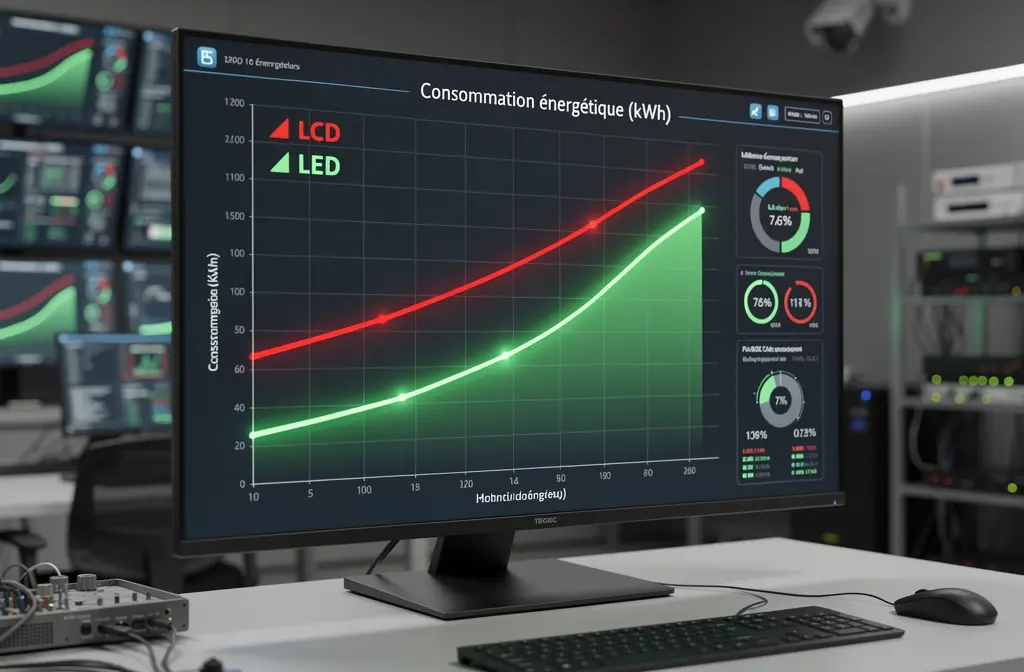
Energy consumption represents a crucial expense for any permanent installation. For equivalent brightness, an LED screen requires 30 to 50% less electricity than a CCFL LCD screen. Over 24/7 operation, this reduction translates into substantial savings and a lighter environmental footprint.
Energy Efficiency and Operating Savings
A 2 m² LED panel consumes approximately 120 watts continuously, while its CCFL LCD equivalent requires nearly 170. Over one year, this gap represents 438 kWh not consumed—a budget difference that quickly offsets the initial investment in LED technology. Lower consumption, even illumination, and extended lifespan thus improve the overall return on investment of the project.
| Parameter | LED Screen (2 m²) | CCFL LCD Screen (2 m²) | Difference |
| Continuous consumption (W) | 120 W | 170 W | -29% |
| Annual consumption 24/7 (kWh) | 1,051 kWh | 1,489 kWh | -438 kWh |
| Annual cost (€ at $0.15/kWh) | $157.65 | $223.35 | -$65.70 |
| Lifespan (hours) | 80,000 – 100,000 h | 30,000 – 60,000 h | +33% to +233% |
LED diodes generate far less heat than CCFL tubes, which preserves internal components, reduces the need for active ventilation, and limits mechanical wear. This mastery of backlighting guarantees extended lifespan and consistently optimized energy consumption.
Brightness and Readability in Extreme Conditions
Thanks to high-performance backlighting, LED lifespan frequently reaches 100,000 hours, while CCFL LCD backlighting rarely exceeds 60,000 hours. Fewer replacements mean significantly less frequent maintenance interventions and lower costs for the user.
An LED panel can deliver between 5,000 and 10,000 cd/m² of brightness, compared to only 250 to 500 cd/m² for classic LCD screens. Thus, a 4,000 cd/m² LED display remains perfectly visible in full sunlight, while a comparable LCD becomes unreadable. This superiority makes LED technology indispensable for storefronts, facades, and outdoor signage.
OLED Technology Compared to LED and LCD
OLED technology, based on organic light-emitting diodes, allows each pixel to emit its own light without a dedicated backlight. This design significantly reduces thickness, eliminates any parasitic light, and offers pixel-level brightness control, producing elevated contrast well beyond that of traditional LCD technologies.
Unique Advantages of OLED Technology
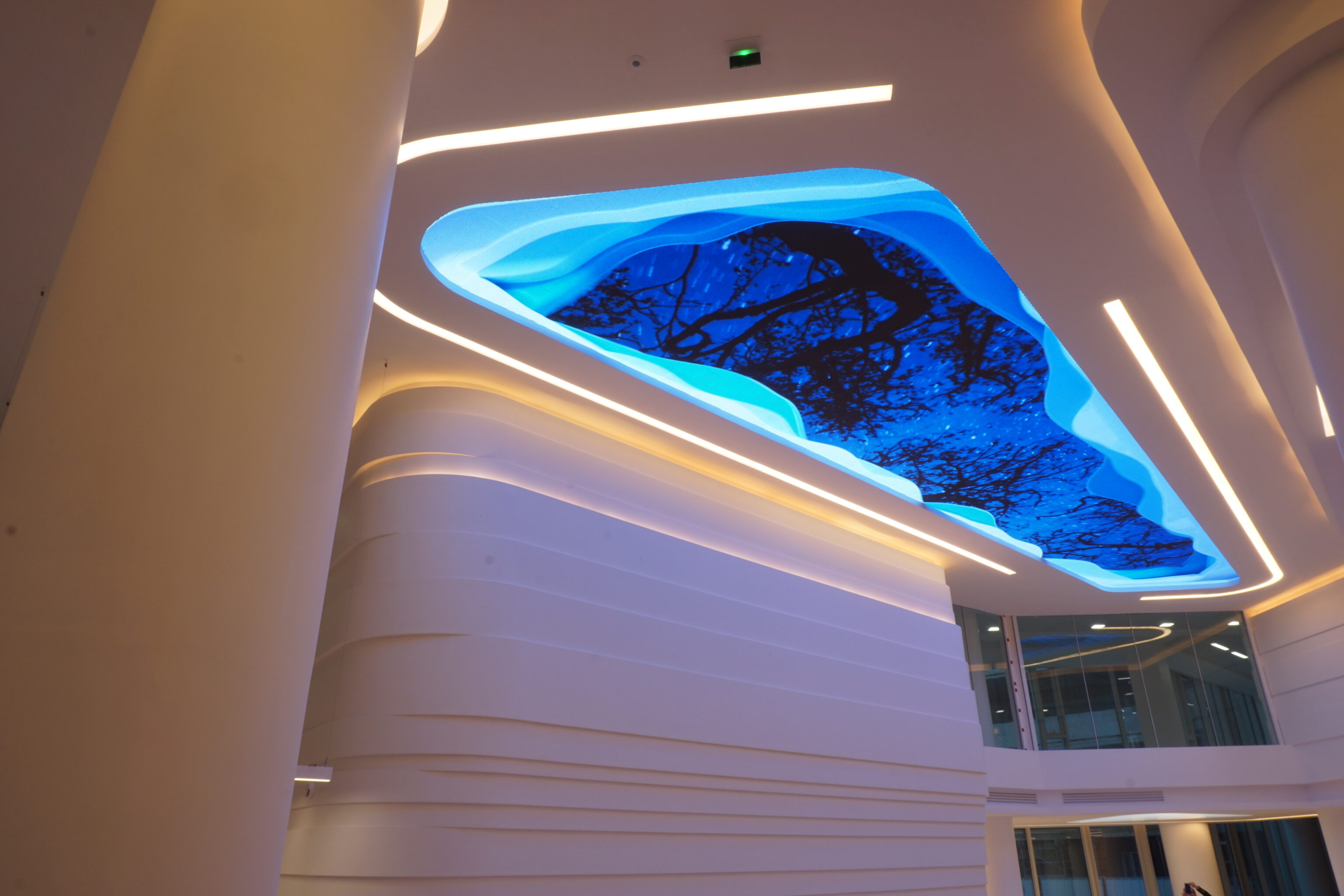
Thanks to independent pixel extinction, OLED screens produce absolute blacks and exceptional image quality, where LCD panels always show a slight residual glow. Their extremely fast response time (under 0.1 ms) preserves motion clarity, improving visibility during gaming, sports broadcasts, or action movies.
- Absolute blacks: Pixels shut off completely, eliminating any residual light typical of LED or LCD screens.
- High contrast: The ratio between brightness and darkness easily exceeds 10,000:1, offering unmatched image depth.
- Ultra-fast response time: Under 0.1 ms guarantees lag-free display with no motion blur.
- Minimal thickness and flexibility: The absence of a backlight enables curved panels, transparent panels, and innovative foldable screens.
Because they need no backlight layer, OLED screens are exceptionally thin and light, paving the way for foldable smartphones or futuristic wearable devices. However, LED and LCD technologies still dominate the large-format market: in the former case, stackable modules make it easy to create enormous display surfaces without visible seams, while LCD and OLED panel sizes remain limited by manufacturing constraints.
Modularity and Maintenance of Professional Screens
For large-scale installations, the modular LED display technology offered by FlexLedLight simplifies installation and maintenance: each panel can be replaced individually, reducing costs and downtime. By contrast, an OLED screen or a single-unit LCD monitor often requires complete panel replacement in case of failure, extending response time and increasing expenses.
LED screens with magnetic-mounted modules allow easy installation on metal frames. FlexLedLight performs structure calculations for custom projects—a crucial service for very large displays. This enables projects where bold formats and screen sizes become key design elements without compromising construction safety.
Which Screen to Choose for Your Professional Use
For meeting rooms, offices, or reception areas, LCD remains a pertinent option: its panels offer wide viewing angles, excellent 4K image quality, and a controlled cost. In these low-light indoor environments, the moderate brightness of LCDs or OLEDs generally suffices to ensure comfortable visibility.
Outdoors or in spaces exposed to intense ambient light, LED screens are the clear choice: their high brightness, resistance to the elements, and IP65 certification guarantee optimal visibility, even in full sun. FlexLedLight thus offers custom solutions for storefronts, facades, or public signage, requiring high contrast and extended lifespan.
When the visual experience relies on deep blacks and striking contrast, OLED remains unbeatable for high-end cinema, competitive gaming, or post-production. However, its acquisition cost, the complexity of manufacturing in large formats, and sometimes reduced lifespan under intensive use still curb its massive adoption compared to the already mature LED and LCD technologies.
Frequently Asked Questions
What is better: LED or LCD for a permanent storefront installation?
For a permanent storefront installation, an LED screen is today the most performant and durable display solution. With brightness between 5,000 and 10,000 cd/m², its panel remains perfectly readable even in full sunlight, while its lifespan reaches 80,000 to 100,000 hours.
Even if the initial investment appears higher than with an LCD, its energy consumption—30 to 50% lower—quickly reduces the electricity bill and maintenance costs. Over five to seven years, the savings offset the equipment, especially since FlexLedLight transparent LED screens install directly on the storefront while maintaining excellent viewing angles.
Does an LCD screen strain the eyes less than an LED screen?
No screen type is inherently less straining; visual discomfort primarily depends on brightness, flicker, refresh rate, and displayed content. A properly calibrated LED panel running at 144 Hz or higher can therefore be easier on the eyes than an old, poorly set-up LCD.
For close workstations, many users still appreciate LCD panels, whose fine resolution and wide viewing angles ensure consistent visual comfort. FlexLedLight calibrates every professional screen to optimize energy consumption, stabilize brightness, and maximize lifespan, thereby reducing fatigue during extended use.
What is the technical difference between an OLED screen and LED or LCD screens for professional signage?
OLED offers perfect blacks and contrast nearly infinite that no classic LED or LCD screen can match. However, its outdoor brightness remains limited to about 800–1,000 cd/m², and producing large panels remains complex and expensive.
For outdoor signage requiring over 4,000 cd/m², LED overwhelmingly dominates, while OLED excels in galleries or museums where display quality takes priority over light output. LCD panels retain an economic advantage for offices; in practice, FlexLedLight directs clients toward LED for outdoor use, OLED for premium indoor experiences, and LCD when minimal energy consumption takes priority over budget.