
The digital display universe offers two distinct options: standard LED screens and LED 3D screens. Each of these technologies serves specific needs. This guide aims to clarify their differences, both technically and visually, to help you make the right choice.
What Is an LED 3D Screen and How Does It Work?
Unlike traditional 2D display, an LED 3D screen generates a perception of depth without the viewer needing to wear special glasses. It uses autostereoscopic technology. Pixels, coupled with optical modulators, project two slightly different images toward each eye, creating an immediate and natural 3D effect.
How Optical Components Work
While standard LED screens display a flat 2D image, LED 3D screens integrate sophisticated optical components such as cylindrical lens arrays, parallax barriers, or lenticular grilles. Their role is crucial: they physically separate the images intended for the left eye from those intended for the right eye. This separation is the foundation of stereoscopic vision and the sense of depth, all without any accessories.
The principle is similar to that of animated postcards. Autostereoscopic technology directs light at very precise angles, so that each viewer receives two images with a slight offset. The brain interprets this offset to reconstruct a single scene in three dimensions, offering an immediate immersive experience.
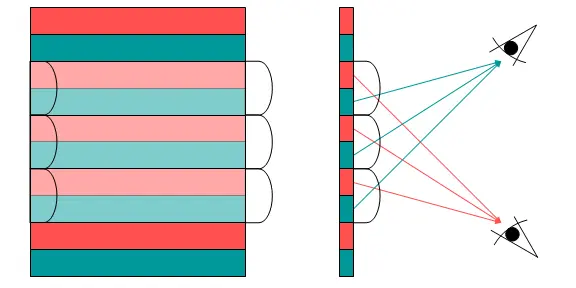
- Lenticular lenses: They divide the display into fine vertical strips that are alternately directed to the left and right eyes, significantly enhancing the sense of relief.
- Parallax barriers: These are thin membranes that selectively block certain pixels for each eye. This optical process optimizes the separation of the two images needed for stereoscopic vision.
- High refresh rate: A rate reaching up to 3840 Hz guarantees perfectly fluid movement and eliminates any flickering, thus preserving the quality of the 3D effect.
- Precise synchronization: Perfect pixel alignment between the two visual channels is essential to maintain a comfortable, distortion-free immersive experience.
The integration of these devices modifies the very structure of the LED facade, enabling innovative designs (flat, L‑shaped, or curved) that further enhance the perception of depth and the dynamics of the display.
Hardware Architecture and Stereoscopy Controllers
The basic technology—the light-emitting diodes themselves—is identical between standard LED screens and LED 3D screens. The added complexity lies in integrating the optical components (lenses, barriers), which demands extreme mechanical precision. This unique architecture is fundamental to producing and maintaining faithful stereoscopic vision.
The heart of the system is the dedicated controller. Autostereoscopic technology requires processing power capable of perfectly synchronizing multiple video streams. These specialized processors handle signal decoding, converting images into stereoscopic formats, and millimeter-accurate alignment of the views, ensuring homogeneous and fully successful 3D display.
Visual Performance: 3D Display vs. 2D
The image quality of an LED 3D screen significantly surpasses that of a standard 2D model. The difference primarily comes down to key factors like contrast, brightness, response time, and the precise synchronization of stereoscopic channels, essential for an authentic and immersive depth perception.
Contrast, Brightness, and Deep Blacks
Thanks to precision local dimming, LED 3D screens achieve exceptional contrast levels, often exceeding 5000:1. This enables genuinely deep blacks, which significantly reinforce the depth effect in stereoscopic mode. The use of black resin between the LEDs effectively blocks light leakage, further accentuating this effect.
With a brightness capable of reaching 5,000 to 10,000 cd/m², the display remains perfectly clear and legible even in strong sunlight. This makes it an ideal solution for storefronts or outdoor installations.
| Feature | LED 3D Screen | LED 2D Screen | LCD Screen |
| Contrast | >5000:1 | 3000:1–4000:1 | 800:1–1200:1 |
| Brightness (cd/m²) | 5000–10000 | 4000–8000 | 400–800 |
| Response time | <5 ms | <3 ms | 8–12 ms |
| Color gamut | DCI-P3 | DCI-P3 or sRGB | sRGB |
| Local dimming | Full-array | Full-array | Global backlight |
Resolution, Pixel Density, and Artifact Reduction
In 3D mode, the native resolution is split between the two eyes—a 1080p LED screen therefore delivers only about 540p per eye. Opting for a 4K or higher resolution helps minimize ghosting effects, reduces the visibility of the pixel grid, and preserves detail sharpness for a more comfortable experience.
Optical diffusion slightly scatters light, which can reduce perceived brightness, but local dimming technology typically compensates for this loss. Careful calibration ensures perfect alignment of the left and right eye images, guaranteeing coherent and uninterrupted stereoscopic display.
Frame Sequencing Synchronization and Response Time
Full-array LED 3D screens support high refresh rates, often 120 Hz or more. This ensures smooth and rapid alternation of views in active systems, crucial for comfort. Their response time of less than five milliseconds significantly reduces motion blur when two offset images are displayed successively.
Dedicated and powerful video processors handle 3D decoding, image conversion, and precise zoned backlight management. This sophisticated architecture preserves stereoscopic integrity and limits artifacts, even during dynamic content like video games or fast-paced sequences.
Viewing Angles and Optimal Perception Zone
The performance of an LED 3D screen primarily depends on the viewer’s position. The closer the observer is to the center, the more intense the depth perception becomes. The area of maximum stereoscopic effect offers a remarkable immersive experience, while the screen shape can either enhance or diminish this 3D effect.
Stereoscopic Effect Zone and Ideal Viewing Distance
The 3D effect peaks within a cone of 30° to 40°, generally positioned 9 to 24 meters in front of the LED screen. Wide viewing angles allow multiple people to simultaneously enjoy excellent visibility and enhanced depth perception, which is ideal for high-traffic locations.
- Optimal central zone: This is where the depth and the illusion of a “floating” element are most striking.
- Lateral degradation: On the sides, the effect fades and the content appears flatter, whereas a standard 2D LED screen remains legible up to about 160°.
- Viewing distance: For optimal comfort, a distance of two to three times the screen height is recommended.
- Motion recognition: Some modern systems adjust depth in real-time using sensors that track audience movement.
When stepping outside this privileged zone, depth perception gradually diminishes and the image may appear flat or slightly distorted. L‑shaped or curved LED 3D screens nevertheless enhance this immersive experience by creating the illusion that the content extends beyond its physical frame.
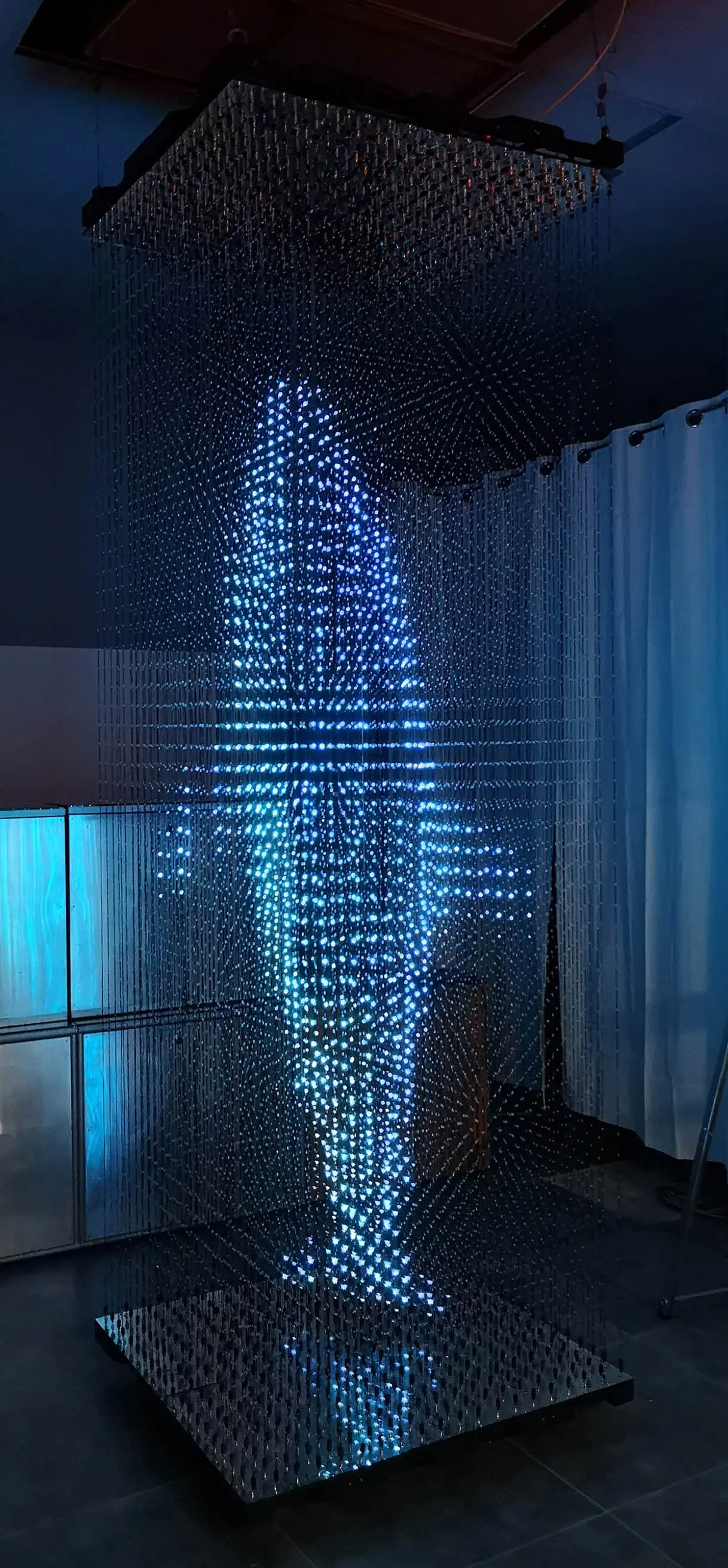
Modular LED screens, similar to Lego assemblies, allow the creation of giant walls, cylinders, or even 360° surfaces. For outdoor installations, a waterproof enclosure (IP65+) paired with a brightness exceeding 5,000 nits guarantees visibility, contrast, and exceptional stereoscopic rendering, even in direct sunlight or harsh weather.
Geometric Configurations and Curved Modular LED Screens
Atypical designs—such as curved panels, L‑shaped structures, or cylinders—widen the viewing angles, enhance perceived depth, and magnify the 3D effect. This approach transforms the relationship between space and image: light reaches the eye at different angles, turning the LED screen into a window into a three-dimensional universe.
Applications and Content Creation for LED 3D Screens
LED 3D screens are ideal for applications where visual impact is paramount. This justifies their acquisition cost and 3D content costs, which are higher than those of a standard 2D system. Their remarkable apparent depth and high brightness instantly catch the eye, significantly improving the visibility of messages.
Stereoscopic Content Production and Dedicated Software Tools
Stereoscopic display requires two video streams or multiple views, generated with specialized software like Blender or Maya, since plain 2D video produces no depth effect. The creation process involves modeling, depth map calculation, and rendering specifically adapted to LED 3D screens. This complexity increases production costs and often requires the expertise of specialized agencies.
Powerful graphics processors then decode these streams, synchronize the image for each eye, and drive the backlight. This guarantees perfect stereoscopic coherence with no perceptible offset.
- Blender: offers native stereoscopic rendering through fully configurable twin cameras.
- Maya: provides advanced modeling tools and allows semi-automatic creation of depth maps.
- Depth maps: these are grayscale images that assign a distance to each pixel to create a credible relief effect.
Professional Use Cases and ROI
In outdoor signage, high-end storefronts, and building facades, LED 3D screens benefit from excellent visibility even in broad daylight, thanks to their high brightness. Exhibition stands, museums, and shopping malls exploit depth to make products, artworks, or architectural models truly memorable.
To make the right choice, decision-makers must evaluate the initial price against the expected benefits: increased foot traffic, better message retention, and sales growth driven by an immersive experience. 2D screens remain a relevant option when depth brings no concrete advantage.
- Outdoor signage: ideal for large-scale advertising campaigns that instantly capture attention.
- Exhibition stands: perfect for showcasing vehicles, luxury products, or architectural projects.
- Cultural spaces: museums and art galleries use them to enhance visitor immersion.
- Immersive cinemas: enable the installation of lightweight panoramic screens, totem-style displays, or even ceiling-mounted screens.
Energy Consumption and Compared Operating Costs
At equal brightness, an LED 3D screen generally consumes between 20% and 40% more energy than an equivalent 2D model. This higher consumption is explained by its higher LED density and the light loss caused by the additional optics. These operating expenses add to the already higher initial purchase price.
Regular maintenance is also more specialized: it includes lens cleaning, stereoscopic recalibration, and specialized technical assistance, which increases the total cost of ownership. Subscribing to a predictive maintenance contract therefore becomes essential to protect this investment over the entire lifespan of the display.
Frequently Asked Questions
What is an LED 3D screen and how does it work?
An LED 3D screen relies on specific 3D LED display technology that uses lenticular lenses or parallax barriers. These components divide the image into two distinct, slightly offset streams, each intended for one eye. This separation maintains the stereoscopic synchronization necessary for a stunning naked-eye 3D effect, offering a realistic depth perception and striking relief, far superior to that of standard LED screens, regardless of viewing angle.
What are the main differences between LED 3D screens and standard LED screens regarding brightness and contrast?
Thanks to advanced local dimming, LED 3D screens typically achieve a contrast of around 5,000:1, whereas a standard LED screen settles for 3,000 to 4,000:1. Their brightness is also more intense, ranging from 5,000 to 10,000 cd/m². This increased brightness compensates for the natural light loss caused by the glasses-free 3D technology, ensuring a clear and visible display even under strong ambient lighting.
Which screen should I choose for my application: 3D or standard 2D?
The choice between an LED 3D screen and a standard 2D model primarily depends on your applications, desired visual impact, and budget. For storefronts, professional exhibitions, or outdoor 3D LED installations, LED 3D display screens and 3D LED video walls create a remarkable depth effect that instantly captures attention. For standard signage where a wide viewing angle is paramount, standard LED screens are often sufficient and offer a more affordable cost.