This complete guide to LED video walls walks you through your custom display project. Discover the key technical criteria, the different types of LED video walls available, and practical advice for optimal installation and maintenance. Choose the LED screen that fits your needs, control your budget, and ensure optimal performance for your custom screen.
What Is a Custom LED Video Wall?
A custom LED video wall is an innovative display solution made of LED modules assembled to form a large, custom-sized screen. This technology transforms visual communication thanks to its remarkable flexibility, perfectly adapting to demanding commercial, event, and architectural spaces.
Definition and Essential Components
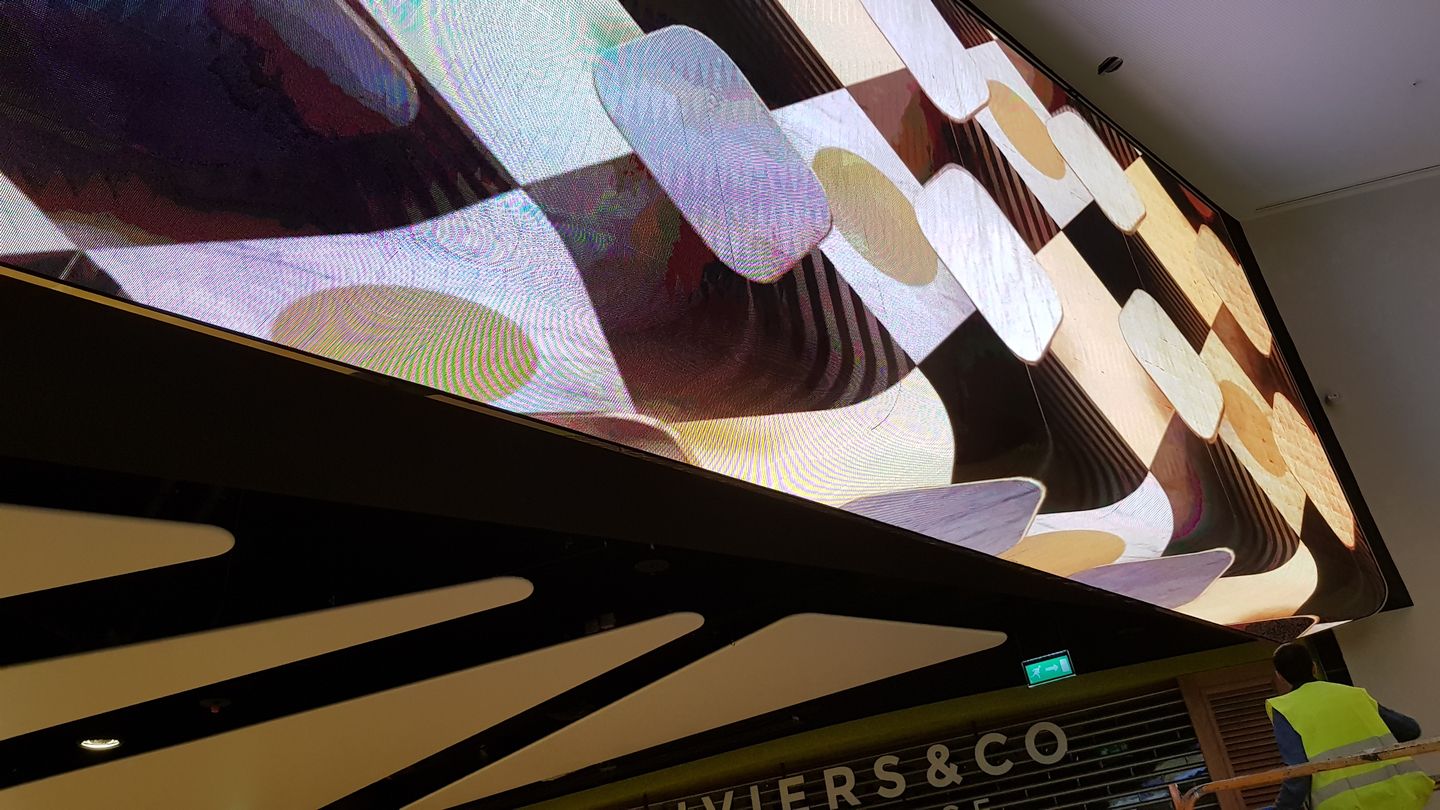
A custom LED screen is made of modular modules that seamlessly assemble to create a continuous display surface. Each module integrates light-emitting diodes precisely arranged to form high-density pixels, guaranteeing exceptional image quality. This design makes it possible to create wall-mounted screens in any size and shape — whether rectangular, curved, or more unusual.
Video controllers form the core of the system, broadcasting the digital signal to each module while maintaining perfect synchronization. These processors automatically adjust content and resolution to the specifications of your custom screen. The electrical power is intelligently distributed with redundant systems to ensure uninterrupted operation.
This article details the advantages of LED by presenting the different types of walls (COB/RGB strips, silicone neon lights, spotlights, projectors), control technologies (DMX, DALI), and best installation practices. It highlights the energy efficiency, durability, and versatility of LED for a variety of applications, as well as custom solutions that allow you to design and control modular LED video walls. Check out our complete guide for designing your custom LED video wall.
Resolution, Pixel Pitch, and Viewing Distance
Pixel pitch is the fundamental technical parameter that directly impacts the image quality of your LED video wall. This measurement precisely defines the space in millimeters between two adjacent LED diodes, determining image sharpness based on your viewing distance. The smaller this value, the closer the image resolution will be discernible, thanks to a higher pixel density.
To help you choose, here is our detailed guide: when the viewing distance is between 1 and 3 meters, opt for a pitch between P1.2 and P2.5 to achieve the best resolution. For distances of 3 to 6 meters, pitches from P2.5 to P4 maintain remarkable clarity. In larger spaces (6–10 m), P4–P6 models are ideal. Finally, for distances over 10 meters, a pitch beyond P6 is the optimal choice without compromising visual quality.
This balance between distance and technical settings allows you to optimize your investment. For example, a luxury boutique will generally choose a P1.5–P2 pitch, while an outdoor installation can comfortably use a P6–P10 pitch.
Advantages Over Traditional Technologies
LED video walls far outperform conventional LCD screens thanks to their perfectly homogeneous display surface, free of any unsightly bezels. This advantage becomes crucial for creating fully immersive environments where every detail matters.
Their impressive brightness (reaching up to 10,000 nits vs. only 700 nits max for LCDs) ensures exceptional visibility even in challenging lighting conditions, making them the perfect solution for outdoor installations.
We present here a range of innovative LED screens adapted to every configuration: transparent versions (up to 92% transparency), curved models, 3D solutions, and custom creations. These technologies offer exceptional contrast and adapt perfectly to various environments (museums, storefronts, event spaces). Explore these cutting-edge solutions designed for extraordinary visual projects.
Advanced LED Video Wall Types and Applications
LED video walls come in different versions to precisely meet the requirements of every project. From transparent screens to immersive 3D installations, each solution offers unique capabilities and remarkable creative possibilities.
Transparent Screens and 3D Technology
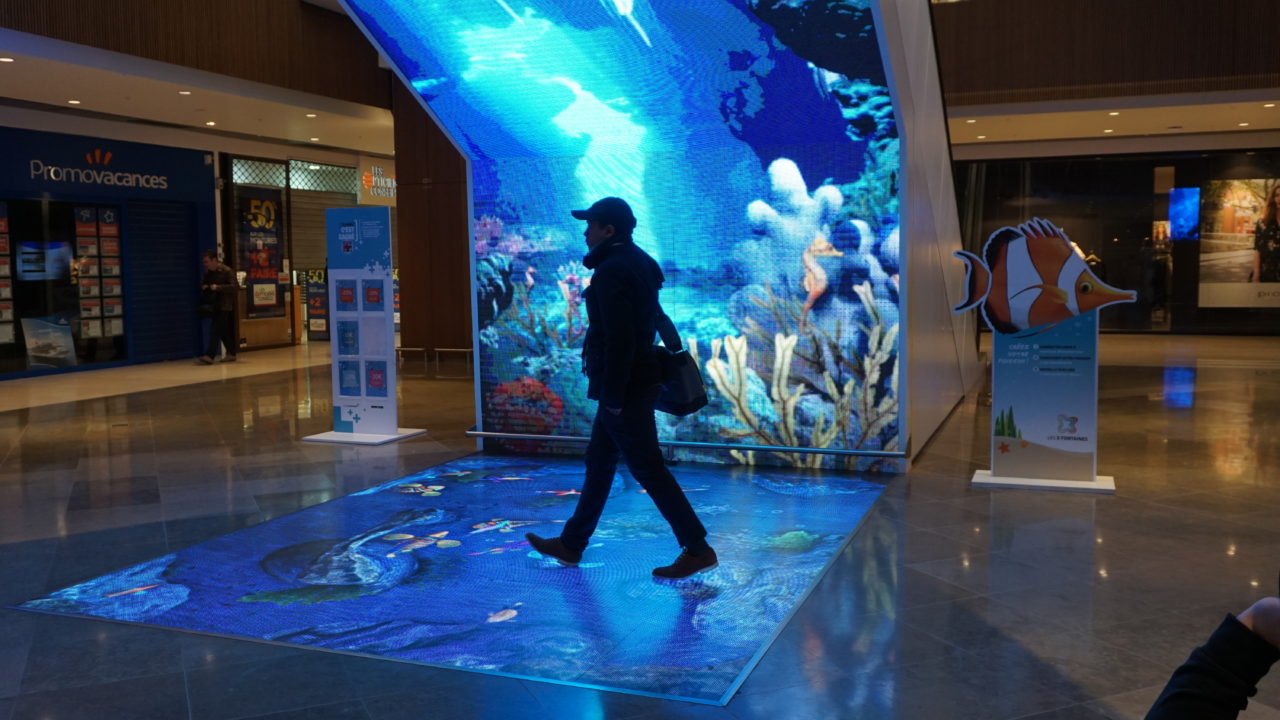
Transparent LED screens mark a true revolution in the field of digital display. The LED glass version combines exceptional transparency (~92%) with excellent readability even at a distance, while the “side LED” model offers a higher pixel density (transparency ~75%), ideal for close-range presentations in commercial spaces. These technologies redefine the experience of storefronts and cultural venues.
Ledpulse 3D systems radically transform the visual experience with captivating relief content. Particularly suited to spectacular events and exhibitions, these screens create total immersion thanks to impressive depth effects that enhance any scenography.
Our catalog also includes custom opaque curved screens, enabling bold architectural shapes for unique integrations. These specific modules adapt to the constraints of complex facades, urban corners, and demanding commercial spaces.
Modular Solutions and Special Configurations
The flexibility of LED video walls is demonstrated by an extensive range of formats adapted to every use: fine-pitch panels (P0.9–P2.5) for premium spaces, event modules for large surfaces, and transparent solutions for architectural integrations. A flagship store would, for example, opt for a P1.9 offering optimal image quality between 1 and 3 meters.
Our modular systems allow you to design video walls in unusual shapes (curved, angular, organic) thanks to assemblable elements. These special configurations integrate perfectly into the most demanding environments, such as corporate lobbies requiring curved structures with refined mounting.
As a perfect complement to our LED video walls, we develop LED solutions integrated into design luminaires. These exclusive creations combine lighting and dynamic display, in the spirit of customizable suspensions incorporating LED panels or strips for a harmonious visual identity.
Essential Technical Criteria for Choosing Your LED Screen
To select a LED screen suited to your needs, several key technical parameters directly influence performance and lifespan. This guide helps you choose the ideal solution for your project.
Pixel Pitch and Image Quality
Pixel pitch is crucial for a custom LED video wall. This distance between the centers of the diodes directly impacts final resolution. A finer pitch offers better image quality at close range:
- Fine pitch (P1.2–P2) for premium spaces where the audience is close
- Medium pitch (P2.5–P4) for lobbies and trade show booths
- Wide pitch (P6+) for panels intended for large spaces
Color reproduction depends on the LED technology used:
- SMD for high-density indoor applications
- DIP for certain installations requiring enhanced brightness
The final rendering (contrast, color temperature, chromatic fidelity) directly influences visual impact. Quality electronic components guarantee color stability over time for your LED video wall.
A light-emitting diode (LED) generates light via an electrical current, with specific materials determining the emitted color. This technology delivers sharp and vivid images for outdoor LED video walls. Real-world performance depends on the overall design, cooling system, and electrical supply. LEDs have revolutionized digital display thanks to their responsiveness, reliability, and extensive color palette — essential characteristics for designing a high-performance screen. Learn more about how LEDs work and their use for LED video walls.
Brightness and Use Environment
Adapt brightness to your installation environment:
- 800–1,200 cd/m² for standard indoor use
- 5,000–8,000 cd/m² for outdoor LED video ensuring optimal visibility in full sunlight
A high refresh rate (≥ 3,000–6,000 Hz) avoids unpleasant flickering. Professional color calibration ensures perfect uniformity across your entire display, crucial for large advertising screens.
Hardware Architecture and Maintenance
The technical design relies on interchangeable modules facilitating interventions, including front maintenance when rear access is impossible. This system integrates redundant power and data transmission for critical installations, optimized thermal management (active or passive cooling), and appropriate IP protection for outdoor conditions (IP65 rating). Lifespan ranges from 50,000 to 60,000 hours, with a recycling program at end-of-life.
For continuous applications such as control centers, our solutions offer front-access bays, backup power, and a remotely controllable video processor. This architecture guarantees maximum reliability for operational use.
Custom Installation and Integration
Implementing a custom LED video wall requires rigorous integration of technical, aesthetic, and functional aspects. This crucial step directly determines long-term performance and user comfort.
Site Preparation and Load-Bearing Structure
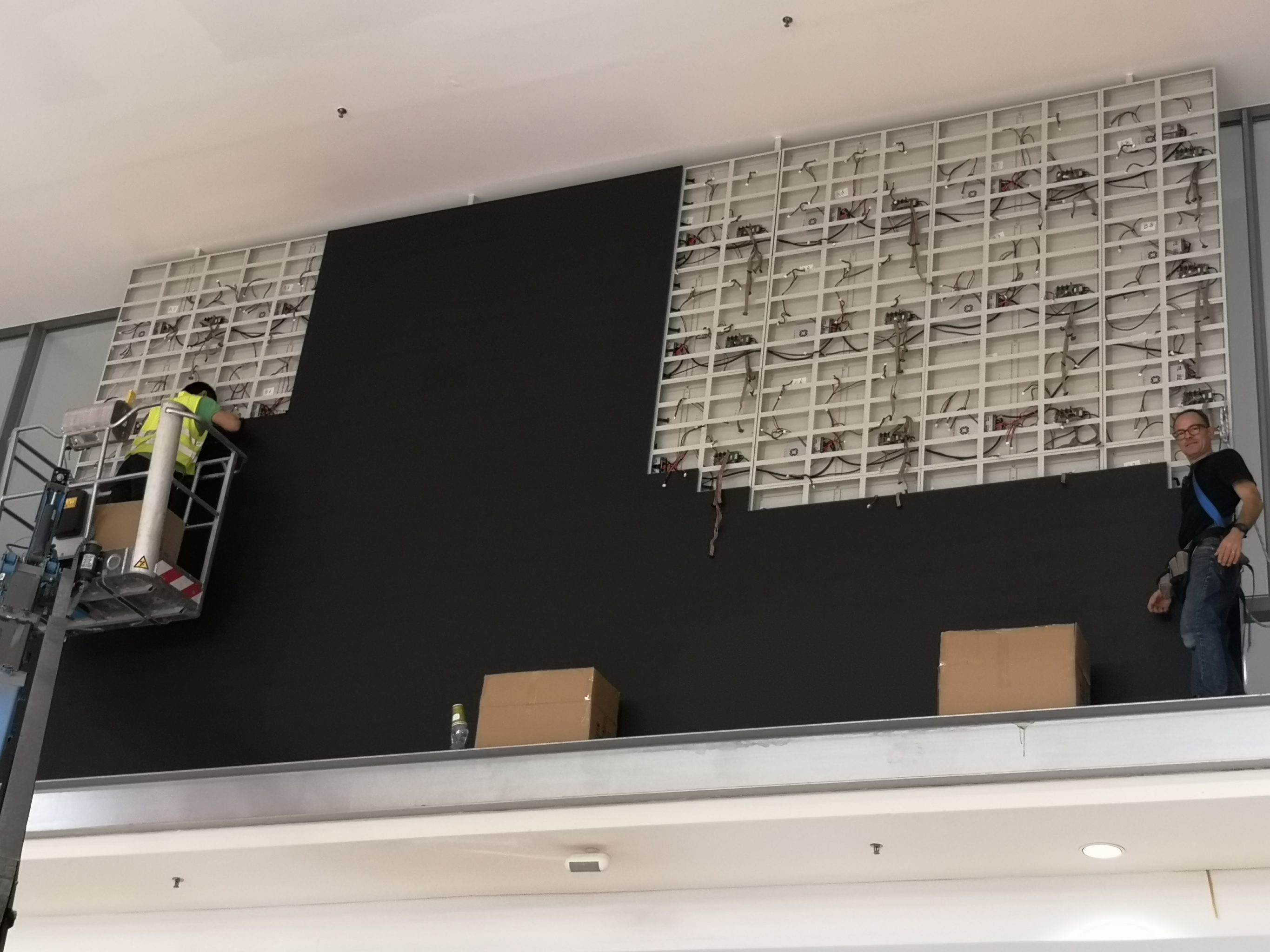
Site preparation includes flatness checks, support structure analysis, mounting point positioning, and wiring organization (power and data networks). For outdoor installations, a resilient frame, drainage system, and appropriate thermal regulation are essential. Indoor installations, on the other hand, require ultra-flat modules and simplified maintenance access.
The modular system simplifies assembly with standardized bays (e.g., 500×500 or 640×480 mm), lightweight and offering front or rear access depending on spatial constraints. This flexibility allows quick panel replacement with automatic recalibration guaranteeing visual uniformity.
Content Management and Electronics
Management is handled via a video processor capable of mapping each pixel to merge various sources and resolutions. The system integrates periodic color calibration and automatic brightness adjustment based on the environment via dedicated sensors. In a commercial setting, the wall synchronizes playlists, scheduled programming, and dynamic display zones thanks to an integrated video processor.
The software management allows you to design content adapted to the native format of the screen, avoiding illegible fonts on large formats and optimizing video content based on usage contexts. This approach maximizes visual impact and communication effectiveness.
Maintenance and Longevity
The maintenance plan includes a spare parts inventory, regular checks (contrast, uniformity, waterproofing), hot-swap replacement procedures, and a reactive service contract. 24/7 installations have pre-configured backup modules and annual calibration checks, with an eco-friendly approach including component recycling.
Our custom LED video walls now integrate innovative LED technologies for fully customizable architectural lighting. These installations elegantly combine light and display, with lighting rails perfectly synchronized with the LED video wall for absolute visual coherence.
Sector Applications and Use Cases for LED Screens
LED video walls transform the visual experience across all industry sectors. From retail to artistic installations, these solutions offer unique capabilities that traditional display methods cannot replicate.
Retail and Local Commerce
For shops and storefronts, the goal is to attract attention with an ultra-sharp image and intense brightness (3,000–4,500 cd/m²), paired with impactful dynamic content. Some chains, such as pharmacies, use high-definition screens to broadcast clear messages and promotions that can be updated remotely, thus increasing their draw.
Large surfaces deploy modular LED video walls in strategic areas. Indoors, a medium resolution (P2.5–P4) with brightness of 600–1,500 cd/m² is preferred. For exterior storefronts, brightness is enhanced with high IP ratings and easier maintenance. This technology revolutionizes the customer experience and optimizes product visibility.
Events and Cultural Spaces
Our partner Option 1 in Dubai positions itself as a true innovation laboratory, showcasing immersive technologies and digital display solutions. Its installations demonstrate the spectacular use of LED video walls for impactful communications and interactive experiences, offering valuable inspiration for integrating an LED video wall in event or commercial contexts. Discover screen interaction powered by AI.
Stadiums and event venues rely on large-format modular panels with exceptional brightness and ultra-fast response time. These systems enable real-time display, perfect content synchronization, and dynamic advertising, optimizing visual impact while controlling installation costs.
Premium and Institutional Applications
Luxury brands and jewelry stores prioritize extreme resolution and perfect color reproduction to showcase their products. The screen integrates discreetly above counters or in storefronts, with simplified access for invisible maintenance that preserves the exclusive ambiance of the space.
In institutional settings, reliability and color precision are essential. Our LED screens maintain constant colorimetric calibration, crucial for respecting brand guidelines and maximizing communication effectiveness. Their advanced connectivity ensures smooth integration into existing infrastructures.
Budget and Return on Investment for LED Screens
Acquiring a custom LED video wall is an investment whose cost varies based on several technical and usage parameters. Our detailed guide helps you estimate your project by specifying the key elements that impact the final price and your return on investment.
Determining Price Factors
The price of a LED screen depends primarily on its technical characteristics: resolution (pixel size), maximum brightness, surface area to cover, and protection level. For an outdoor installation requiring IP65 protection and high brightness, budget an additional 40–60%, justified by specific technical requirements.
- Pitch and resolution: reducing the pitch by 0.5 mm increases the price by 30–50% due to manufacturing complexity
- Brightness performance: going from 1,000 to 5,000 nits entails a 25–40% supplement thanks to high-end LEDs
- Display surface: scale economies appear from 15 m² onward with tiered pricing
- Technical options: advanced features (fast refresh, COB technology) add 15–25% to the base price
Electrical consumption significantly influences operating costs. A modern LED wall consumes between 200 and 400 W/m² depending on brightness and the type of content broadcast. This energy efficiency, superior to LCD screens, allows substantial savings over 7 to 10 years.
Ancillary Costs and Services
Additional expenses represent 20–35% of the total budget: support structure, electrical supply, control system, and professional installation. These components guarantee longevity and optimal performance for your personalized LED display system.
This document presents recent LCD panel technological advances applicable to LED video walls: improved response times, new manufacturing techniques, and the evolution toward LED backlighting matrices. These innovations produce screens that are thinner, brighter, with better contrast and optimal color reproduction — essential criteria for the quality of an LED video wall. Discover LCD innovations and LED backlighting to optimize your LED video wall.
Frequently Asked Questions
How do I choose the right pixel pitch for my LED video wall?
To determine the ideal pixel pitch, consider the viewing distance from the screen above all else. Close viewing (1 to 3 meters) requires a small pitch (P1.2 to P2.5) guaranteeing perfect sharpness. Between 3 and 6 meters, a medium pitch (P2.5–P4) is the best option. Beyond 6 meters, wider pitches (P4 to P6+) offer high image quality of great quality without unnecessary additional cost.
What is the lifespan of an LED video wall?
A high-end LED video wall typically has a lifespan of 50,000 to 60,000 hours under standard operation — that’s 10 to 12 years with 12 hours of daily use. Actual longevity varies based on component quality, cooling efficiency, and maintenance operations. We systematically offer a manufacturer’s warranty complemented by a maintenance program tailored to your installation.
Should I buy or rent my LED screen?
It depends on your usage. Rental, including installation, is perfect for one-off events (trade shows, launches). For permanent or recurring applications (more than 3 months/year), buying becomes more economically advantageous. The investment typically pays back in 18 to 24 months depending on specific features and the size of your custom LED screen.