
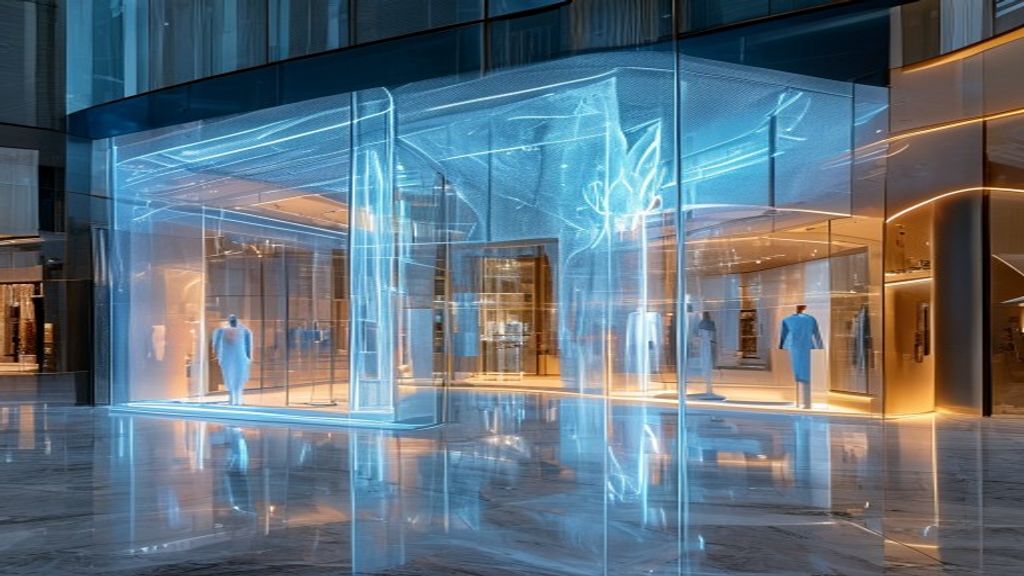
Transparent LED screens turn a glass storefront into a dynamic surface without sacrificing daylight, shopfront visibility or the merchandising depth behind the glass — and in the UAE retail market that combination is genuinely unique. A traditional digital signage screen blocks 100% of the storefront; a transparent LED panel keeps 60–80% of light transmission while still delivering a high-brightness image that competes with mall atrium lighting. For brands fighting for attention in Dubai Mall, Mall of the Emirates, City Walk, Yas Mall, BurJuman or The Galleria, that difference is a real lease-renegotiation lever.
This guide is how FlexLedLight specifies transparent LED storefronts for UAE retailers, from technology choice through power, content rules and ROI.
Choosing a Transparent LED Screen for a UAE Storefront
There is no single “transparent LED” technology. Three families compete in the UAE retail market — clear-resin SMD, LED mesh and LED glass — and they look identical in a Shenzhen showroom and very different on a Dubai Mall storefront at 14:00. The right choice depends on transparency target, brightness budget and how the panel will be cleaned by mall housekeeping at 02:00.
Clear SMD vs Mesh vs Glass for UAE Storefront Use
- Clear SMD transparent panels. Cabinets carry SMD LEDs along vertical or horizontal strips with the remainder of the surface transparent. Transparency runs 60–80% depending on pitch (P3.91 transparent ≈ 65%; P7.81 transparent ≈ 80%). Brightness typically reaches 5,500–6,500 nits, which is enough for any mall storefront and most semi-outdoor canopies but not for direct sun on Sheikh Zayed Road.
- LED mesh. A flexible mesh of LED strips. Transparency reaches 75–90%, brightness tops out around 4,500 nits, and the panel is light enough to drape on irregular shapes. Mesh is the right answer for atrium installations at Dubai Mall, large hanging structures at Yas Marina, and façade re-skinning of older Sharjah retail buildings. Less suited to flat storefronts under 4 m of width.
- LED glass / transparent film. SMD LEDs are laminated between two layers of architectural glass or applied as a film on existing glazing. Transparency 80–90%, brightness 1,500–3,000 nits. Best for the inside face of a glass door or premium boutique window where the screen is genuinely a digital glass element rather than a digital signage panel. Not suitable for outdoor west-facing UAE installs.
For most Dubai Mall, MoE and City Walk storefronts we specify clear SMD transparent panels at P3.91 with 65–70% transparency and 5,500 nits, mounted on the inside face of the storefront glass with an air gap.
Transparent LED vs Solid LED Wall — When Each Wins in the UAE
The reflex of European brands landing in UAE retail is to default to a solid LED video wall behind the glass. Sometimes that is right. Sometimes it kills the storefront.
- Solid LED wins when the merchandising behind the storefront is secondary, when the brand brief is image-led (luxury launch, automotive reveal, watches), and when budget allows for full HVAC compensation to evacuate the heat generated by a 1,200 nit indoor wall running 14 hours a day.
- Transparent LED wins when the merchandise itself is the hero (fashion mannequins, jewellery cases, premium electronics), when natural light is part of the design intent, when energy budget matters (typically 30–50% less consumption than solid), and when the mall landlord limits drilling and structural intervention.
Inside Dubai Mall and Mall of the Emirates we see roughly a 70/30 split in favour of transparent LED for new luxury fit-outs in 2025 and 2026. In City Walk, where storefronts open onto the open-air promenade with semi-outdoor exposure, the ratio reverses toward solid 7,500 nit walls protected by the canopy.
Format and Modularity Against UAE Storefront Architecture
UAE mall storefronts come in a narrow range of widths (typically 4 to 8 m) but a wide range of heights (3 to 9 m for double-height premium units). Transparent LED panels arrive in cabinet sizes of 500 × 1,000 mm, 500 × 500 mm or 1,000 × 1,000 mm and assemble in any rectangular grid.
Three deployment patterns dominate UAE retail:
- Full storefront curtain. Floor-to-soffit transparent grid across the entire opening. Visual impact maximal; cost per square metre × surface large. Suitable for flagship stores at Dubai Mall fashion district or the Mall of the Emirates Galleria.
- Header band. A 1.0 to 1.5 m horizontal transparent strip across the top of the storefront, framing the entrance below. Lower budget, very legible from the mall corridor, leaves the lower glass entirely free for merchandising.
- Side columns plus header. A “Π”-shaped frame of transparent LED panels around the entrance. Premium feel, modular fit to non-standard widths.
For Yas Mall, BurJuman and The Galleria where storefront heights are more constrained, the header band pattern dominates. For Dubai Mall and Mall of the Emirates premium zones, the full curtain pattern is increasingly the standard.
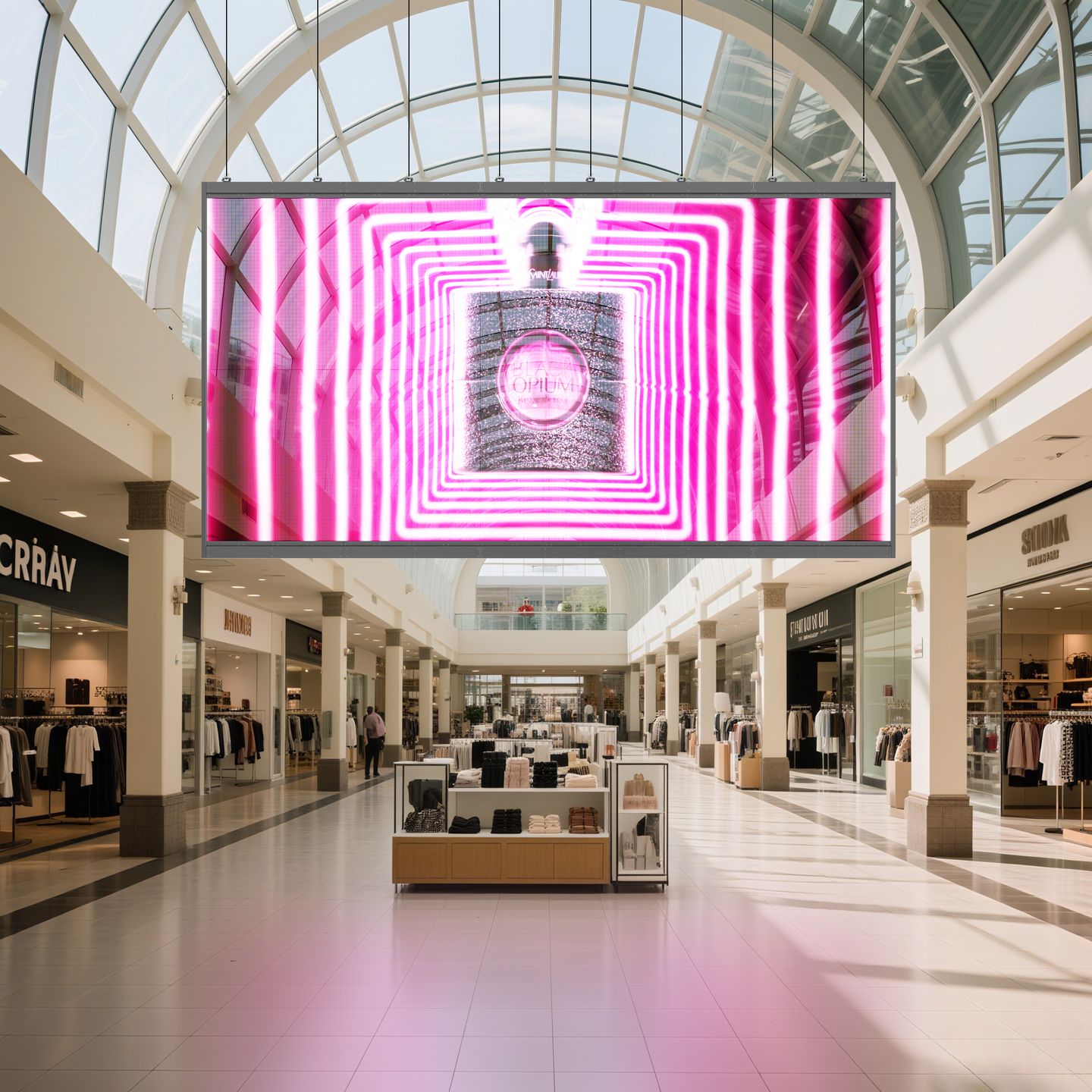
Brightness, Regulation and Content Management in UAE Retail
A transparent LED storefront in the UAE faces a triple constraint: it must compete with bright mall lighting and external glare, it must comply with mall landlord and Dubai Municipality rules, and it must be remotely managed by a brand team that may sit in Paris, Milan or New York.
Brightness and Readability in UAE Mall Light
UAE malls run higher ambient light levels than European malls. Dubai Mall, Mall of the Emirates and Yas Mall atria measure 800–1,400 lux at storefront level during peak hours; European reference malls run 400–800 lux. A transparent LED storefront sized for European mall light will look washed out in Dubai.
The working numbers for UAE indoor mall transparent storefronts:
- Minimum brightness: 4,500 nits for shaded interior storefronts away from skylights.
- Reference brightness: 5,500 nits for typical Dubai Mall and Mall of the Emirates fashion-district positions.
- Aggressive brightness: 6,500–7,500 nits for storefronts directly under skylights or on the open-air levels of City Walk and BurJuman.
Pair the brightness target with a mandatory ambient light sensor that brings the screen down to 30–40% at off-peak hours. Brand content shot in Europe at 100% white-point will burn through a 7,500 nit storefront after closing if the sensor is not enforced.
UAE Regulation of Indoor LED Advertising
Indoor LED advertising in UAE malls is governed by three overlapping layers.
- Mall landlord rules. Emaar (Dubai Mall, City Walk, BurJuman partner sites), Majid Al Futtaim (Mall of the Emirates, City Centre), Aldar (Yas Mall, Reem Mall), Lulu (Galleria Mall) each publish tenant fit-out guides. Brightness caps, content rotation rules and screen-off hours vary by mall. Read the fit-out manual before specifying the screen, not after.
- Dubai Municipality and equivalent emirate authorities. Outdoor and semi-outdoor storefront screens visible from public roads — including most City Walk and Bluewaters Island stores — fall under municipal content approval. Indoor mall screens generally do not, but transparent storefronts visible from car park entries can be reclassified.
- National Media Council content rules. Apply across all visible digital signage in the UAE. No alcohol, pork, gambling, or content offensive to Islamic values. Ramadan rules apply to all visible screens during fasting hours, including indoor mall storefronts (no eating, drinking, or culturally insensitive imagery during daylight).
Brand teams managing content remotely from outside the UAE should keep a Ramadan-compliant content set ready and a UAE-based content approver in the workflow. Several brands have been forced to dark their Dubai storefront for 72 hours during Ramadan after running European campaign content.
Remote Content Management for UAE Retail Networks
A premium UAE retail network with five to fifteen storefronts across Dubai, Abu Dhabi, Sharjah and possibly Riyadh needs a content management system that handles:
- Multi-site scheduling including per-emirate calendar (UAE National Day on 2 December, Ramadan, Eid al-Fitr, Eid al-Adha, Dubai Shopping Festival, F1 Abu Dhabi week).
- Per-store brightness control synchronised to mall opening hours, which differ between Dubai Mall (10:00–24:00) and Mall of the Emirates (10:00–23:00).
- Emergency content swap within 30 minutes for compliance incidents.
- Camera-feed verification so the brand HQ in Europe can verify what is actually on screen in real time.
FlexLedLight ships our UAE transparent storefronts with a cloud-managed content platform that handles all four out of the box, with content servers replicated regionally for sub-second response.
Price, Power and ROI of a UAE Transparent LED Storefront
A UAE transparent storefront project has three cost layers: hardware, install + power infrastructure, and ongoing operation. Underestimating any one of them is the most common procurement mistake.
Cost of a Transparent LED Storefront in the UAE
Indicative UAE delivered prices per square metre, hardware + cabinet + power supply + control:
- P3.91 transparent SMD, 5,500 nits, 65% transparency: AED 12,000–18,000 per m².
- P7.81 transparent SMD, 5,000 nits, 80% transparency: AED 7,500–11,500 per m².
- LED mesh, P15.6, 4,500 nits, 85% transparency: AED 5,500–9,000 per m².
- LED glass / film, P10, 2,500 nits, 85% transparency: AED 14,000–22,000 per m².
Add 25–35% for installation, structural mounting, control cabinet, signal distribution, commissioning and ECAS certification on a typical Dubai Mall fit-out. A 6 m × 3 m header band P3.91 transparent storefront in Dubai Mall lands fully delivered at roughly AED 280,000–360,000.
For comparison, the equivalent solid LED video wall behind the same opening lands at AED 180,000–240,000 — but the transparent option preserves storefront merchandising, cuts power consumption by 35–45% and avoids dedicated HVAC compensation.
Power Consumption and DEWA Tariff Optimisation
A transparent LED storefront draws less than a solid wall because much of the surface is empty. Typical figures:
- P3.91 transparent at 5,500 nits, average brightness 60%: 350–450 W/m².
- P7.81 transparent at 5,000 nits, average brightness 60%: 250–320 W/m².
- LED mesh at 4,500 nits: 180–240 W/m².
For an 18 m² header band running 14 hours/day at 60% average brightness, P3.91 transparent consumes roughly 35–45 kWh/day, or 12,800–16,400 kWh/year. At DEWA’s 38 fils/kWh commercial tariff that is AED 4,900–6,200/year in electricity — and you can shave another 25–35% with a tighter ambient sensor profile and a 02:00–06:00 mandatory off window.
Brand teams used to European tariffs sometimes ignore UAE power cost on the basis that “DEWA is cheap”. DEWA commercial rates are not cheap by global standards; they are in line with central European rates, and on a ten-year ownership horizon the difference between a properly tuned and an over-bright UAE storefront is AED 30,000–60,000 of avoidable cost.
ROI and Commercial Upside in UAE Retail
The case for a transparent LED storefront in the UAE rarely closes on electricity savings. It closes on three commercial levers:
- Footfall capture. Internal Emaar and MAF mall data shared with us shows transparent-fronted boutiques in the Dubai Mall fashion district pull 18–35% more first-time visitors than equivalent static-front units in the same corridor.
- Lease negotiation. Landlords increasingly grade tenants on storefront animation. A transparent LED storefront moves a tenant up the grading scale, which translates directly into renewal terms.
- Brand campaign agility. Switching the storefront message for a launch, a regional collaboration or a sponsored Dubai Shopping Festival activation takes minutes, not weeks. For brands running 8–12 campaign moments a year across UAE stores, the cost of physical visual merchandising changes drops by 40–60%.
Payback windows we observe on premium UAE retail clients: 18–28 months for a header band on a Dubai Mall or Mall of the Emirates fashion storefront, 30–42 months for a full curtain on a flagship.
Frequently Asked Questions on UAE Transparent LED Storefronts
What Does a Transparent LED Storefront Cost for a UAE Boutique?
Delivered cost for a typical Dubai Mall or Mall of the Emirates header band of 12 to 24 m² lands at AED 230,000–420,000 fully installed, including structure, control, ECAS certification and commissioning. The same surface as a full storefront curtain runs AED 450,000–820,000. Mesh or LED-glass solutions reduce hardware cost by 30–50% but rarely match the visual punch of clear SMD transparent in a bright mall atrium.
What Transparency and Brightness Should a UAE Storefront Screen Have?
For Dubai Mall, Mall of the Emirates and similar premium UAE malls, target 65–70% transparency at 5,500 nits, with P3.91 transparent SMD as the default pitch. Drop to 80% transparency at the cost of perceived sharpness for premium boutiques where the merchandise behind the glass must remain the visual hero. Move up to 7,500 nits for any semi-outdoor or skylight-exposed position at City Walk, BurJuman or The Galleria.
How Do You Install a Transparent LED Storefront on a UAE Mall Storefront?
Installation runs in five phases: structural survey of the storefront opening against the landlord fit-out manual; mounting frame fabrication in marine-grade aluminium; cabinet hanging on the inside face of the glass with a 30–80 mm air gap for thermal management; power and data distribution from a control cabinet typically located in the back-of-house; commissioning with calibration, content load and remote-management activation. Permits and landlord approvals from Emaar, Majid Al Futtaim, Aldar or equivalent must be filed early — Dubai Mall and Mall of the Emirates approvals take three to six weeks depending on storefront position.
Working With FlexLedLight on a UAE Transparent Storefront Project
A transparent LED storefront is the most visible single intervention a UAE retail brand can make short of a full refit. The technology choice, the brightness, the content rules and the maintenance plan all need to be calibrated to UAE conditions and to the specific mall fit-out manual.
FlexLedLight runs every UAE transparent storefront project through the same workflow:
1. Mall fit-out audit — landlord rules, brightness caps, structural limits, ECAS path. 2. Transparency and brightness specification — calibrated to the storefront position and ambient mall light. 3. Content management and Ramadan compliance — UAE-resident approver in the loop. 4. Power and DEWA / ADDC alignment — connection sized to the install, not retrofitted. 5. Preventive maintenance contract — calibrated for sand, humidity and mall housekeeping access.
Whether the project is a header band in Dubai Mall, a full curtain at the Mall of the Emirates, a mesh canopy at City Walk or a glass-laminated screen at a Yas Mall flagship, we deliver hardware pre-certified for UAE conditions with a maintenance plan calibrated for the climate.
Contact us for a UAE transparent storefront quotation or browse our LED screen catalogue to start scoping your project.