
A LED video wall in a UAE shopping mall is half hardware decision, half landlord and content negotiation — and the projects that go well are the ones that get all four sides right from day one. Dubai Mall, Mall of the Emirates, City Walk, Yas Mall, BurJuman, The Galleria, Reem Mall and the new Dubai Hills Mall each run different fit-out manuals, different tariffs and different brand approval flows. A spec that ships fine into a Paris or Munich mall will often miss the mark — too dim, wrong pitch, wrong cabinet, wrong content workflow — by the time it lands in the UAE.
This guide is how FlexLedLight scopes giant LED installations for UAE shopping malls, from technology choice through power, content rules, install logistics and ROI.
LED Video Wall Technologies for UAE Shopping Malls
The UAE mall market has converged around three dominant pixel technologies — COB, SMD and GOB — each with a clear role. Choosing wrong adds 20–40% of avoidable cost or shortens the screen’s useful life under mall housekeeping conditions.
COB vs SMD for UAE Indoor Mall Use
- SMD (Surface-Mount Device). The industry default. Three LEDs (R, G, B) sit in a single package soldered to the PCB. Pitch options from P1.2 to P10. Strong colour gamut, easy to service module-by-module. Vulnerable to mechanical shock — a vacuum-cleaner pole at 02:00 in Dubai Mall can crack five diodes on contact. Right answer for premium fashion-district mall walls where access is supervised.
- COB (Chip-on-Board). LEDs are mounted directly on the PCB and encapsulated in resin. No package above the PCB surface. Strong mechanical and chemical resistance, far easier to clean, slightly higher initial cost. Right answer for high-traffic mall positions where the screen is within touch range — corridor pillars at Mall of the Emirates, central atrium walls at City Walk and Reem Mall, kid-zone screens at Yas Mall.
- GOB (Glue-on-Board). SMD covered with a transparent resin layer. Mechanical resistance close to COB at a price closer to SMD. Right answer for budget-constrained mall positions where touch resistance matters but full COB is overkill.
For UAE mall fashion-district walls and premium atrium installations we default to COB at P1.5 to P2.5. For drive-by mall façades visible from car park entries, SMD outdoor at P4 to P6 still dominates.
Brightness and Pitch by Viewing Distance Inside UAE Malls
UAE mall ambient light is brighter than European norms — 800 to 1,400 lux at storefront level during peak hours. Spec brightness and pitch against the actual viewing distance, not the catalog reference.
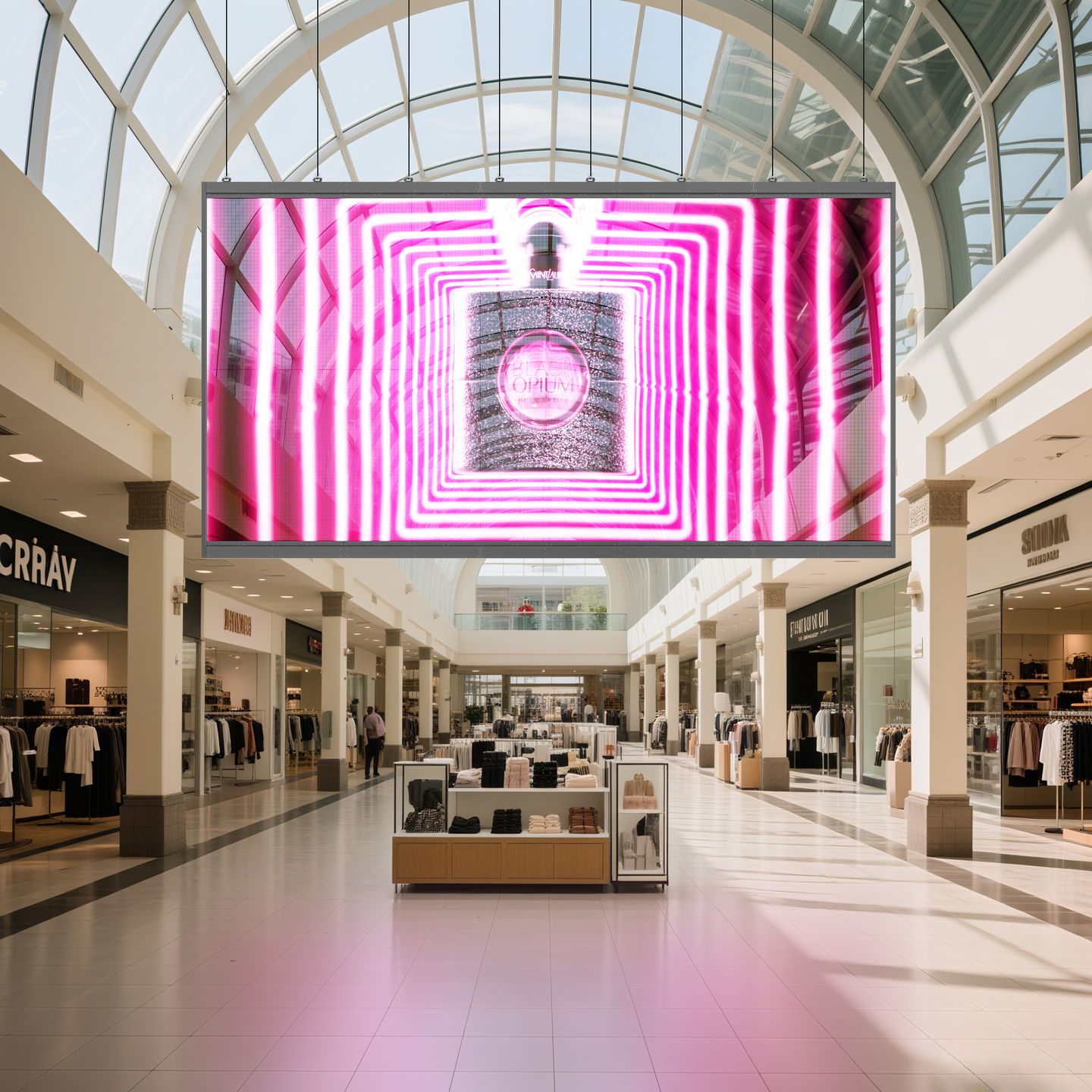
- Atrium centrepiece, 6–12 m viewing depth, hanging or pillar-mounted: P2.5 to P3.91 indoor, 1,200–1,500 nits.
- Corridor wall, 3–6 m pedestrian distance: P2 to P2.5 indoor, 1,000–1,200 nits.
- Storefront frame inside a tenant unit, 2–4 m viewing distance: P1.5 to P2 indoor, 800–1,000 nits.
- Mall entrance facing the car park, semi-outdoor: P4 to P6 outdoor-spec, 4,500–6,500 nits.
- External billboard on the mall façade: P8 to P10 outdoor, 7,500–8,500 nits.
Most of the UAE mall network shifted from P3 to P2.5 between 2023 and 2025. Dubai Mall fashion district is now standardising on P1.9 and P2.5 for new fit-outs; Mall of the Emirates is on P2.5 to P3 for the same use case.
Design and Architectural Integration in UAE Malls
UAE mall architecture sets video wall design choices in ways European malls rarely do.
- Atrium scale. Dubai Mall, Mall of the Emirates and Yas Mall atria reach 25–40 m of vertical clearance. Hanging LED installations at 8–12 m above the floor are normal and require structural anchorage above the false ceiling. Engage the mall structural engineer early — retrofitting anchor points into a finished atrium runs to AED 80,000–180,000 extra.
- Sightlines. UAE mall corridors are wider than European norms (8–14 m), which pushes viewing distances out and pitch coarser by half a step versus Paris or Berlin equivalents.
- Skylight management. Dubai Mall and Mall of the Emirates atria use large skylights. A wall positioned under a skylight needs +1,500 nits over the reference brightness to avoid washout.
- Heat and HVAC compensation. A 60 m² mall video wall releases 12–22 kW of heat. Mall HVAC plants in the UAE run hard already; the mall management will require an HVAC compensation note from a qualified engineer before approving the install. Budget 8–14 weeks for that approval.
Storefront and Screen Size for Each Mall Space
A mall video wall fails commercially when it is sized for the budget rather than the space. The two recurring sizing mistakes we correct on UAE projects are oversized walls in narrow corridors and undersized walls in atria.
Transparent Storefront Screens in UAE Malls
When a tenant wants to combine a digital storefront with merchandise visibility, transparent LED is the right answer. We cover the full transparent storefront playbook for UAE retail in a dedicated guide, but in a mall video wall context the headline rules apply: P3.91 transparent at 65–70% transparency and 5,500 nits is the Dubai Mall and Mall of the Emirates default; LED mesh at 4,500 nits is the right answer for atrium installations at City Walk and Yas Marina; LED glass and film are reserved for premium boutique inside faces where the screen is genuinely a digital glass element.
Choosing the Right UAE Mall Video Wall Size
Three rules anchor sizing on UAE mall projects.
- Width matches viewing-distance cone. At a 6 m viewing distance, the comfortable visual angle is 60°, which is roughly 7 m of wall width. A 4 m wall at the same distance underplays; a 12 m wall pushes content off the natural sightline.
- Aspect ratio matches content strategy. 16:9 for cinematic and brand content, 21:9 for product reveal, 4:1 ribbons for header bands, 3:4 portrait for vertical-first social and luxury reveals (increasingly common in Dubai Mall fashion district).
- Surface area meets the mall lease floor. Most Emaar, Majid Al Futtaim and Aldar premium fit-out tiers require a minimum animated surface (often 8–18 m²) to qualify for the top brand grading. Sizing the wall below the lease floor forfeits the commercial point of installing it.
LED Video Walls for Advertising Communication in UAE Malls
UAE shopping malls run two distinct LED advertising layers: tenant-controlled walls inside leased units and mall-controlled walls in shared atria, corridors and entrances. Each operates under different rules, different revenue models and different content approval flows.
Programmable LED Billboards and Content Management
Mall-controlled advertising LED billboards in the UAE operate as CPM (cost per thousand impressions) inventory sold by the mall’s media arm. Typical reference rates for shared mall LED inventory in 2025–2026:
- Dubai Mall central atrium LED ribbon: AED 180,000–280,000 per week for an 8‑second slot in a 60-second rotation.
- Mall of the Emirates ski-slope-facing wall: AED 90,000–140,000 per week for an 8‑second slot.
- Yas Mall main atrium wall: AED 45,000–80,000 per week.
- City Walk semi-outdoor entrance wall: AED 60,000–110,000 per week.
Content scheduling runs on the mall media arm’s platform with a 5–10 working day approval window. Ramadan-specific approvals can extend that to 15 working days. Tenant-controlled walls run on the tenant’s own CMS, with screen-off rules driven by the mall fit-out manual.
Impact and Potential of a UAE Mall LED Wall
The commercial value of a UAE mall LED wall sits in three layers.
- Footfall capture in front of the wall. Premium atrium walls at Dubai Mall and Mall of the Emirates deliver 80,000–180,000 daily impressions during high season (November–April, plus the Eid and Dubai Shopping Festival peaks).
- Footfall capture toward the storefront. Tenant walls visible from the mall corridor pull a measurable lift in storefront entries — internal mall data suggests 12–28% lift for premium fashion units running animated tenant walls versus static branding.
- Campaign agility. Switching content for a launch, a regional collaboration or a Dubai Shopping Festival activation takes minutes rather than weeks of vinyl print and install.
The single biggest mistake we see UAE mall video wall owners make is treating the wall as a static brand surface. The hardware is built for animation; the audience expects it; the lease typically requires it.
Outdoor vs Indoor LED for UAE Mall Advertising
UAE malls increasingly combine indoor video walls inside the corridor network with outdoor LED billboards on the mall façade or car park entrance. The two are different products, not interchangeable.
- Indoor mall LED: P1.5 to P3 indoor, 800–1,500 nits, COB or GOB preferred for touch resistance, ECAS-certified, mall fit-out compliant.
- Outdoor mall LED: P8 to P10 outdoor, 7,500–8,500 nits, IP66 front + IP65 rear, marine-grade hardware within 5 km of the coast, DEWA / ADDC / SEWA / FEWA connection registered, Dubai Municipality content approval (or equivalent emirate-level authority) on file.
Brands often try to push an indoor-spec wall into a semi-outdoor mall entrance to save cost. The result is a washed-out screen within one summer and a full replacement by year three. Outdoor positions get outdoor hardware, no exceptions.
Installation, Cost and Maintenance of a UAE Mall Video Wall
A LED video wall in a UAE mall is a coordinated install, not a screen purchase. Five stakeholders sign off the project: mall landlord, tenant brand, structural engineer, electrical engineer and the AV integrator. Compress any one of them out of the workflow and the install slips.
Key Steps of a UAE Mall LED Install
- Phase 1 — Mall fit-out audit (2–4 weeks). Landlord rules, brightness caps, structural limits, ECAS path, HVAC compensation note. Skipping this phase is the single largest source of UAE mall install slippage.
- Phase 2 — Engineering and approvals (4–8 weeks). Structural calculation against UAE wind and seismic codes, electrical load coordination with DEWA / ADDC / SEWA / FEWA, content approval if the wall is visible from public roads.
- Phase 3 — Hardware procurement (4–10 weeks). Pre-certified UAE-spec hardware ships from FlexLedLight in 5–7 weeks; spare-module pool ships in parallel. Customs clearance at Jebel Ali typically clears in 3–5 working days with full ECAS documentation.
- Phase 4 — Install (3–10 days). Mall installs run overnight (02:00–08:00) per landlord rules. A 60 m² atrium wall takes 4 to 6 overnight sessions.
- Phase 5 — Commissioning and handover (2–4 days). Calibration, content load, CMS handover, training, ECAS certificate delivery, warranty activation.
Full critical-path duration for a typical UAE mall video wall lands at 14–22 weeks from kick-off to first content on screen. Aggressive timelines under 12 weeks are possible for tenants who pre-clear landlord approvals before hardware order.
Power Consumption and DEWA Cost Optimisation
A typical 60 m² mall LED wall in COB P2.5 at 1,200 nits average draws 15–22 kW at peak and 8–12 kW averaged across a 14-hour mall day. Annual consumption lands at 35,000–55,000 kWh, which at DEWA’s 38 fils/kWh commercial tariff is AED 13,000–21,000 per year before HVAC compensation cost.
Three levers cut the bill significantly:
- Ambient light sensor synchronised to mall corridor light. Brings average brightness from 100% to 50–60% with no perceived visual drop.
- Content scheduling. High-brightness content during peak hours (12:00–22:00 weekdays, 10:00–24:00 weekends), low-brightness ambient content outside those windows.
- Off window during mall housekeeping (02:00–05:00). Aligns with mall power-saving expectations and extends LED lifespan by ~1,500 hours per year.
Calibration, Maintenance and Lifespan of a UAE Mall Video Wall
UAE mall video walls operating under properly maintained climate-controlled atria reach 80,000–110,000 hours of UAE-corrected L70, or 14–18 calendar years at 14 hours/day. The maintenance routine that delivers those numbers:
- Quarterly cleaning of cabinet vents and front surface (compressed air for sand, soft microfibre for fingerprints in touch-range positions).
- Bi-annual calibration with on-site colorimeter to correct any chromatic drift, especially in atria with skylight exposure.
- Annual structural inspection of hanging or pillar-mounted installations after any seismic event or after major mall renovation works nearby.
- Year-seven preventive PSU replacement during a planned maintenance window to head off the dominant failure mode.
A preventive maintenance contract priced at 6–9% of capex per year extends UAE mall video wall life by roughly 30% and keeps the screen brand-consistent for the full lease horizon.
Frequently Asked Questions on UAE Mall LED Video Walls
What Does a Giant LED Screen Cost for a UAE Shopping Mall?
A typical 40–80 m² premium atrium video wall in COB P2.5 at Dubai Mall, Mall of the Emirates or Yas Mall lands fully delivered at AED 900,000–1,800,000 including hardware, structure, control, ECAS certification, commissioning and twelve months of preventive maintenance. Semi-outdoor mall entrance walls in SMD P6 at 7,500 nits run AED 11,000–16,000 per m² delivered. Smaller corridor or storefront walls (8–20 m²) start at AED 220,000 delivered.
What LED Screen Size Should You Choose for a UAE Shopping Mall?
Anchor sizing to viewing distance and brand visibility floor: 20–40 m² for corridor and pillar positions, 40–80 m² for primary atrium centrepieces, 80–180 m² for flagship mall façade walls at Dubai Mall, Mall of the Emirates, Yas Mall or Reem Mall. Sub-15 m² installs rarely earn the campaign agility that justifies the LED format over premium static signage.
Indoor or Outdoor LED Screen for a UAE Shopping Mall?
Both, for different roles. Indoor walls (COB or SMD P1.5 to P3, 800–1,500 nits) drive in-mall brand experience and tenant storefront visibility. Outdoor walls (P6 to P10, 7,500–8,500 nits, IP66 front) drive footfall capture from arteries like Sheikh Zayed Road, E11, E311 and Yas Island circuits. A mall network that runs only one of the two leaves measurable revenue on the table.
Working With FlexLedLight on a UAE Mall Video Wall Project
A UAE mall LED project succeeds when the landlord, the tenant, the structural engineer, the electrical engineer and the AV integrator are aligned before the first cabinet ships. Specifying the screen in isolation is the most expensive mistake in the market.
FlexLedLight runs every UAE mall video wall through the same workflow:
1. Mall fit-out and landlord audit at Dubai Mall, Mall of the Emirates, City Walk, Yas Mall, BurJuman, The Galleria, Reem Mall or Dubai Hills Mall. 2. Site-measured viewing-distance and brightness specification against ambient mall light. 3. Structural and HVAC compensation engineering signed off by a UAE-registered consultant. 4. DEWA / ADDC / SEWA / FEWA power coordination sized to the install. 5. Preventive maintenance plan calibrated for sand, mall housekeeping cycles and ECAS-compliant spares.
Whether the project is a flagship atrium centrepiece in Dubai Mall, a corridor wall in Mall of the Emirates, a transparent storefront in City Walk, an outdoor entrance billboard at Yas Mall or a P1.9 fashion-district fit-out at Reem Mall, we deliver hardware pre-certified for UAE conditions with a maintenance plan calibrated for the climate.
Contact us for a UAE mall LED video wall quotation or browse our LED screen catalogue to start scoping your project.