
A professional LED screen is sold on a 100,000-hour datasheet number — but in the UAE that number is almost never the lifespan the client actually gets. Heat above 50 °C, fine sand, coastal humidity in Dubai and Abu Dhabi, plus daytime operation in direct Gulf sunlight, all stress LED hardware in ways that European brochures do not account for. After ten years of UAE installs we see the same pattern: a screen specified for “Europe + Africa” rarely makes it past five years on a Sheikh Zayed Road façade; a screen specified for UAE conditions hits 12 to 14 years of strong service.
This guide explains what actually drives LED screen lifespan in the Emirates, how to read the datasheet through a Gulf filter, and what changes between an outdoor installation in Dubai, a mall install in Abu Dhabi and a corporate wall in DIFC.
Professional LED Screen Lifespan in the UAE — What the Numbers Really Mean
Manufacturers quote LED screen lifespan as the number of operating hours before brightness falls to 50% of the original value — the L50 metric. Premium UAE-grade panels reach 100,000 hours at L50; entry-level imports collapse to 30,000–50,000. The headline number is meaningful, but it assumes lab conditions: 25 °C ambient, 30% humidity, no dust ingress, 80% rated brightness, 8 to 10 hours per day of operation.
UAE installs run hotter, brighter, longer and dirtier. The realistic number worth budgeting against is what we call UAE-corrected L70 — the hours until 70% original brightness under typical Gulf duty cycle. That is the threshold where viewers actually start to notice fade, not the catalog L50.
How Many Hours and Years Does a UAE LED Screen Really Last?
Translating manufacturer hours into UAE calendar years requires three corrections.
- Daily operating hours. A Dubai Mall storefront runs 16 hours/day. A Sheikh Zayed Road billboard runs 18 to 20 hours/day. A DIFC trading floor runs 24/7. A corporate lobby in ADGM runs 12 hours/day. The same screen lasts vastly different calendar lifetimes depending on duty cycle.
- Brightness duty. Running at 100% brightness shortens life roughly by half versus running at 50% with an ambient light sensor. UAE outdoor screens that auto-dim from 8,500 nits at noon to 2,500 nits at night gain four to five years of usable life.
- Thermal duty. Every 10 °C of additional cabinet temperature roughly halves the life of the power supply electrolytic capacitors and accelerates LED diode degradation. The difference between a properly cooled UAE cabinet and a Europe-spec cabinet on the same façade is measured in years, not months.
Across our UAE projects, realistic L70 lifespan looks like this:
- Premium UAE-spec outdoor screen, 16 h/day, ambient light sensor, full preventive maintenance: 12 to 14 years.
- Premium UAE-spec indoor mall screen, 14 h/day, climate-controlled atrium: 13 to 16 years.
- Premium UAE-spec transparent storefront, 12 h/day: 9 to 11 years.
- Mid-range outdoor screen with passive cooling, no ambient sensor: 5 to 7 years.
- Cheap import screen, no UAE certification, 18 h/day on Sheikh Zayed Road: 2.5 to 4 years.
The spread is wide and the cheap-import number is what most “value” tenders deliver. The cost gap between a UAE-spec and an import screen is roughly 30–45% at purchase; the cost gap over a ten-year ownership period — including replacement, downtime and DEWA reconnection — is typically 200% in favour of UAE-spec.
What Shortens LED Lifespan in the UAE Climate
Five mechanisms drive nearly every premature LED screen failure we see in the Gulf.
- Heat soak through the cabinet. Direct sun on a west-facing Dubai façade pushes the cabinet skin past 70 °C from May through September. Inside, the driver ICs run another 15 to 20 °C hotter. Cheap power supplies derated for 55 °C ambient cook within 18 months.
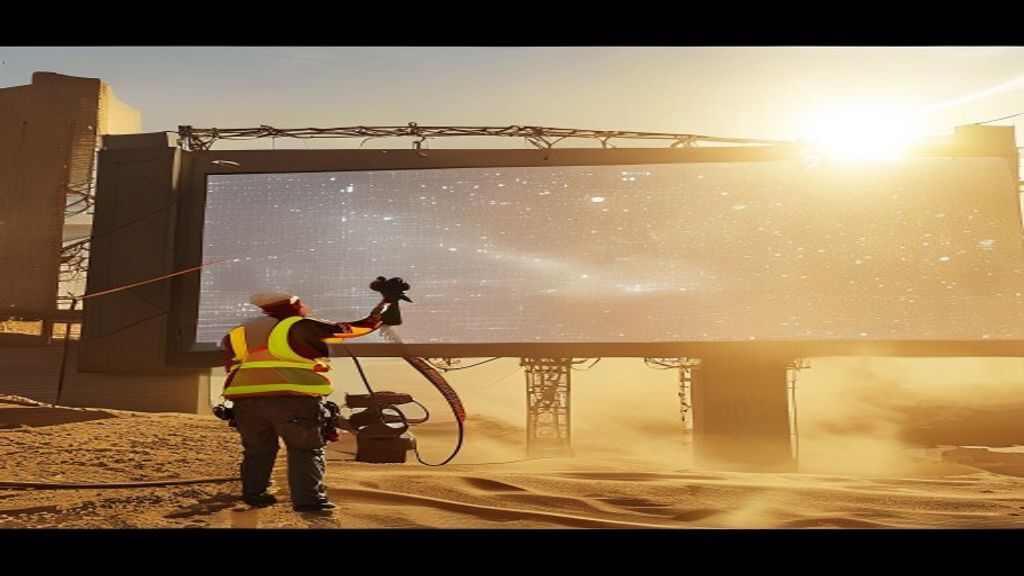
- Fine sand ingress. UAE airborne sand routinely measures below 50 µm. It slips through IP54 vents in two shamal seasons, lands on driver boards, traps heat and accelerates corrosion. Front IP66, rear IP65 is the only spec that survives long-term.
- Coastal humidity and condensation. Abu Dhabi, Dubai Marina, Sharjah and the entire east coast run 80–95% humidity at night for months. Inland Al Ain and Liwa stay dry by day but condense overnight in winter. Both kill non-conformal-coated boards within five years.
- Salt air corrosion. Within five kilometres of the Gulf shoreline — which includes most of Dubai’s prime billboard locations — chloride attack on stainless 304 fixings is significant. Stainless 316, marine-grade aluminium cabinets and powder-coated frames are mandatory.
- Over-bright operation. Running 7,500 nits all day to be “safe” instead of dimming to 55% average via ambient sensor halves the diode life. This is the single biggest waste in UAE LED procurement.
A sixth, softer factor: content brightness profile. A screen showing high-contrast video 16 hours a day ages faster than one showing soft brand ambient content the same hours. UAE retail clients running luxury brand reels routinely outlast those running aggressive promotional loops.
Extending the Lifespan of a UAE Professional LED Screen
Six interventions, each measured on real UAE projects, add years of usable service.
- Mandatory ambient light sensor. Cuts average brightness from 100% to roughly 55%. Gains 30 to 40% of total operating-hour budget.
- Night-time shutdown (not just dim). Dubai Municipality already restricts most outdoor billboards between 02:00 and 06:00. Use that window to fully shut down the screen, not just dim it. Diode hours saved translate directly into calendar years gained.
- Active cabinet cooling with redundant fans. Specify dual-redundant fan banks with smart airflow management. When internal temperature crosses 55 °C the screen should auto-dim before throttling, not after.
- Quarterly compressed-air vent cleaning. Sand load in the UAE makes this the single highest-ROI maintenance routine. Skipping it is the most common reason a five-year-old screen fails at year six.
- Preventive PSU replacement at year seven. Electrolytic capacitors in the screen’s power supplies are the dominant failure mode after seven years of UAE service. Preemptive replacement during a planned maintenance window costs a fraction of an emergency call-out during Ramadan or GITEX.
- Calibration twice yearly on coastal sites. Humidity-driven colour drift becomes visible at year three on Abu Dhabi Corniche or Khor Fakkan installs. A colorimeter pass at six-month intervals keeps the screen brand-consistent for ten years.
A preventive maintenance contract priced at 6–8% of capex per year extends usable LED screen life by roughly 30% in our UAE portfolio. On any installation above AED 200,000, the contract pays for itself by year four.
Professional LED Screen Warranty and UAE Consumer Protection
Warranty length is often used as a proxy for lifespan, and in the UAE that needs careful reading.
- Standard manufacturer warranty: 24 months for entry-level imports, 36 months for mid-range, 60 months for premium UAE-grade hardware. FlexLedLight ships our UAE outdoor projects with a 60-month panel warranty as standard.
- Power supply and control card warranty: typically half the panel warranty, because PSU is the dominant failure mode. Specify same-warranty PSUs from the start.
- Diode L50 / L70 lifetime statement: distinct from warranty. A vendor can warranty a screen for 36 months while quoting an L50 of 100,000 hours — the lifetime is a target, the warranty is a contract.
- UAE consumer protection (Federal Law No. 15 of 2020, Federal Law No. 24 of 2006): commercial buyers receive limited statutory protection beyond the contract. Negotiation power lives in the warranty wording, not in the law. Insist on parts + labour + on-site coverage, not just parts.
Customs and ECAS registration also matter at end-of-warranty: parts must clear Jebel Ali for replacement work. Specify a UAE-stocked spares pool of at least 5% of installed surface, otherwise a 14-day repair becomes a 6‑week problem.
Frequently Asked Questions on UAE LED Screen Lifespan
What Is the Real Operating-Hour Lifespan of a UAE Professional LED Screen?
Premium UAE-spec hardware reaches 70,000–90,000 hours of UAE-corrected L70, which translates to 12–14 calendar years at 16 hours per day. Imports without UAE certification typically deliver 15,000–25,000 corrected hours, or 2.5 to 4.5 calendar years on the same duty cycle. The headline catalog L50 of 100,000 hours assumes Düsseldorf lab conditions, not a Dubai August at noon.
How Do You Extend the Life of a UAE Outdoor LED Screen Exposed to Weather?
Three interventions matter most. First, mandatory ambient light sensor combined with night-time shutdown — gains roughly 4 to 5 calendar years. Second, quarterly compressed-air vent cleaning to evict sand — prevents the cascading thermal failure that wrecks year-six screens. Third, preventive power supply replacement at year seven — eliminates the dominant failure mode before it triggers downtime during Ramadan, GITEX, the Dubai Shopping Festival or F1 Abu Dhabi.
Can a Giant LED Screen Last More Than 15 Years in the UAE?
Yes, on three conditions. The screen must be UAE-spec from order: IP66 front, −10 °C to +60 °C operating range, marine-grade hardware within 5 km of the coast, stainless 316 fixings, conformal-coated boards. It must operate with mandatory ambient brightness control and a night-time off window. It must be on a preventive maintenance contract with quarterly cleaning, twice-yearly calibration on coastal sites and a year-seven PSU replacement. Without all three, 15 years is wishful. With all three, our oldest UAE installs are already past that mark.
Working With FlexLedLight on a UAE LED Lifespan Specification
LED screen lifespan in the UAE is decided at order time, not at year ten. The components that survive 14 years in the Gulf are different from the components that survive 14 years in Lyon or Manchester. The maintenance routine that protects them is different from a European routine. The duty cycle they run is different from any European duty cycle.
FlexLedLight engineers UAE LED projects with three commitments built into every quotation:
1. UAE-spec hardware as the default, not the upgrade — IP66 front, marine-grade fixings, 60 °C‑rated PSUs. 2. A preventive maintenance plan calibrated for sand, heat and coastal humidity, sized to the duty cycle. 3. A UAE-stocked spares pool that keeps mean-time-to-repair under 72 hours during Ramadan, GITEX and Dubai Shopping Festival peaks.
Whether the project is an outdoor billboard along E11, a retail wall in Dubai Mall, a transparent façade in DIFC, an event screen for an ExpoCity activation or a corporate lobby in ADGM Square, we deliver hardware specified to outlast its warranty and a service plan that keeps it bright.
Contact us for a UAE LED screen lifespan assessment or browse our LED screen catalogue to start scoping your project.